
An appeals judge has recommended the U.S. Health and Human Services uphold a proposed 15-year debarment for a scientist accused of research misconduct more than a decade ago.
In a May 2025 decision, administrative law judge (ALJ) Margaret G. Brakebusch concluded that “undisputed facts” establish Ariel Fernández engaged in research misconduct by falsifying research results in published papers, grant applications and other materials while serving as a professor at Rice University in Houston. Brakebusch recommended HHS affirm the proposed sanctions made by the Office of Research Integrity in a 2022 charging letter — including a 15-year ban from federal funding for Fernández, an Argentine chemist.
The development is the latest in a lengthy saga involving skepticism over Fernández’s work dating back to 2009. Over the years, scientists have criticized his work, journals have investigated his papers, and Fernández has flip-flopped about the funding sources for some of his articles. Fernández also levied a legal threat against Retraction Watch in the past for reporting on an expression of concern in one of his papers.
Fernández denies the misconduct allegations and says he resolved the misconduct case years ago through a settlement with Rice. According to a copy of the 2010 settlement, Rice paid Fernández $240,000 and Fernández agreed to leave the university in 2011. As part of the terms, Rice waived all claims against Fernández and released him from any liability.
Fernández alleges ORI revived the case after a 2021 paper he wrote supporting a lab origin of SARS-CoV-2. Critics of his work at the National Institutes of Health are “weaponizing ORI” by “using research misconduct allegations to discredit individuals such as myself who hold views opposed to the official narrative that upheld the ‘natural’ origin of SARS-CoV-2,” he told us.
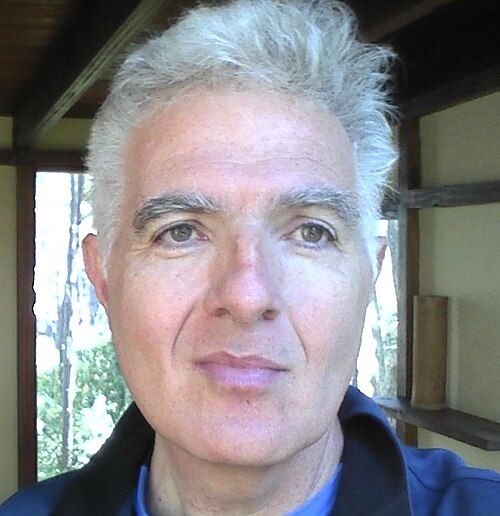
“I have requested the nullification of debarment proceedings that may arise from the recommended decision,” Fernández told us. “The said ALJ granted summary judgment (no hearing) to the Office of Research Integrity, dismissing a colossal amount of exculpatory evidence and the testimonies in my favor from highly qualified experts and witnesses, resurrecting a case that was closed 15 years ago.”
Fernández threatened to sue us back in 2013 after we wrote about an expression of concern placed on his 2011 paper in BMC Genomics. Since then, we’ve written about a paper by Fernández put on hold over data concerns, a series of corrections he made to several articles disclaiming funding from NIH, and an investigation by PLOS Genetics into one of his papers.
Nearly a year after Brakebusch’s decision, however, ORI has not taken action against Fernández, nor posted anything publicly about the case, which stems from a 2009 research misconduct investigation at Rice. While the ALJ’s decision is dated May 22, 2025, the findings were not posted on the HHS website until February.
Fernández worked as a computational scientist at Rice University from 2006 to 2011 where he held the post of the Karl F. Hasselmann Chaired Professor of Engineering, according to a case summary in the ALJ’s decision. Fernández did not conduct experiments or maintain a laboratory, but developed hypotheses based on computational research and collaborated with experimentalists to confirm the theories in their labs, according to the summary.
In May 2009, graduate student Abhinav Tiwari and Fernández were working together on revisions to a manuscript for Trends in Pharmacological Science, the research for which involved combining anticancer drugs to improve therapeutic efficacy.
According to the ALJ summary, Fernández gave Tiwari a PowerPoint file to insert into the manuscript that contained figures representing experimental results. During the revisions, Tiwari noticed “an image in one of the figures had been copied and pasted over an adjacent image.” When Tiwari moved the image, it “revealed a different image that did not support the paper’s hypothesis,” according to the summary. Tiwari asked Fernández about the issue, who assured Tiwari “the results were legitimate, and directed that the manuscript submission go forward.”
Tiwari allegedly became suspicious and re-examined other figures in the manuscript, discovering many of the images were copied and pasted from published articles by different authors for unrelated experiments. He informed leaders at Rice of his findings, and the university initiated a research misconduct proceeding, according to the case summary.
Tiwari did not return messages seeking comment.
In his defense, Fernández claimed it was Tiwari who fabricated information related to the synthesis of one of the compounds and that he colluded with Rice authorities to frame Fernández.
Sean Sessel, who worked on Fernández’s team as an undergraduate at Rice, offered testimony on Fernández’s behalf that Tiwari was responsible for performing the experimental work on the project. Sessel told us he stands by his testimony and said he felt Rice’s investigation into Fernández was “political” with the aim of running Fernández “out of the position” because some Rice leaders didn’t like him.
“The idea that Dr. Fernández would be doing the experiments himself wasn’t congruent with my understanding of the division of labor,” Sessel told us. “When I was asked about this, I made that statement and the university just completely disregarded it.”
Sessel coauthored a 2009 paper with Fernández in Trends in Pharmacological Sciences that was investigated as part of the research misconduct case and found to include falsified research results.
The Rice investigation panel found Fernández acted intentionally to “fabricate, falsify and/or plagiarize research that he submitted for publication,” according to the ALJ’s summary. The panel noted Fernández gave inconsistent explanations of who did the experiments in question and “contradicted himself so frequently that his credibility was seriously compromised.”
For example, Fernández sometimes claimed responsibility for synthesizing a compound called EJ-1, but later “claimed ignorance” of the synthesis. He initially told the panel he could come up with more synthesis details, but later “attributed the synthesis and all experimental work to people at” Eli Lilly Research Laboratories. In his NIH grant application submitted in 2004, Lilly was named as one of three performance sites for the research, according to the case summary.
“While Respondent gave the contact information of individuals at Lilly, and stated that the Panel could contact those individuals, he also threatened to sue the RIO and the Panel for defamation if they suggested to those individuals that they were investigating research misconduct allegations involving him,” Brakebusch wrote in her summary. “Therefore, the Panel did not contact anyone at Lilly to corroborate Respondent’s assertions.”
As part of his defense, Fernández presented a witness statement from Sangtae Kim, former vice president and information officer for Lilly, who said he facilitated interactions between Fernández and different research groups at Lilly and granted Fernández “unrestricted funds to pursue collaborative endeavors with Lilly scientists.” The collaborations led to “sharing of biological and chemical data on exploratory early-stage compounds that were expected to corroborate Fernández’s dehydron-wrapping paradigm,” Kim wrote in an affidavit we have seen.
Kim did not return a message seeking comment.
A spokesperson for Lilly told us the company “was not a party” to the proceedings, and the ALJ “found no evidence any Lilly scientist participated in any of the alleged misconduct described in the decision.”
ORI received Rice’s 92-page report finding “repeated, deliberate acts of research misconduct” on June 30, 2010, and conducted an independent oversight review of the evidence and findings. Twelve years later, on Nov. 9, 2022, Fernández received a charge letter from ORI notifying him of the office’s research misconduct findings. Specifically, ORI made 10 findings that Fernández “intentionally, knowingly, or recklessly engaged in research misconduct by fabricating and/or falsifying research results in 12 published papers, four unpublished manuscripts, one presentation, and three grant applications.”
The research involved was supported by National Institute of General Medical Sciences grant R01 GM072614, which totalled about $1.2 million from 2005 to 2008. The published papers associated with the alleged misconduct included articles in Cancer Research, ACS Nano, and Journal of Chemical Physics, among other journals.
ORI recommended barring Fernández from receiving federal funds for 15 years and sending notice of its findings and the need for retraction and/or correction to the journals of 11 papers.
On Dec. 6, 2022, Fernández submitted a hearing request. Records show the case bounced among HHS administrative law judges for two years. On Dec. 7, 2022, ALJ Carolyn Cozad Hughes was appointed to the case, according to HHS Departmental Appeals Board records. ALJ Judge Karen Robinson later took over the case. On April 3, 2023, ORI filed a motion for summary judgement, according to the ALJ’s case summary. On Dec. 4, 2024, the case was transferred from Robinson to Brakebusch, according to appeals board records.
In her May 2025 decision, Brakebusch wrote an oral hearing was “unnecessary,” and that ORI’s allegations were supported overwhelmingly by undisputed material facts. She recommended HHS uphold the actions proposed by ORI.
”As initially determined by Rice, Respondent’s research misconduct squandered Rice and NIH funds, the time and resources of scientists and engineers who have tried to follow up on his work, and the time and energy of his departmental personnel and other people connected with this case,” she wrote.
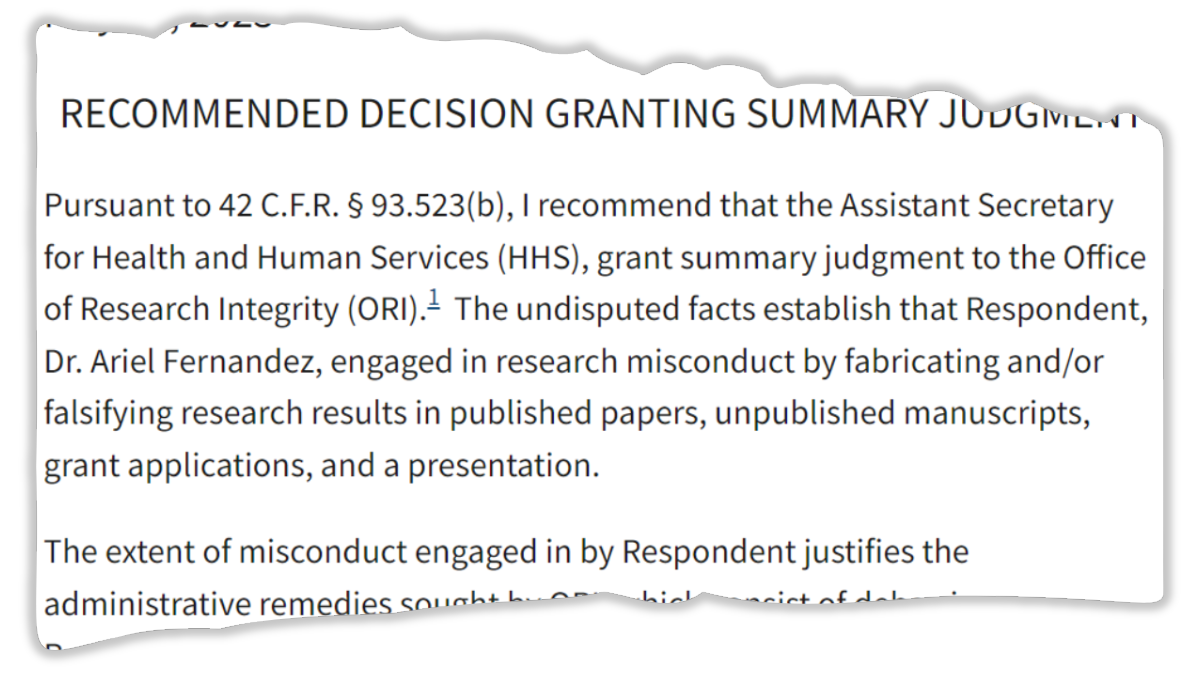
Fernández disputes Brakebusch’s findings that his defenses against the misconduct claims were “irrelevant” and “without factual foundation.”
In the 2010 settlement between Rice and Fernández, the university had agreed to terminate its misconduct investigation against Fernández and issue no formal findings or sanctions. At the time of the agreement, the university had already sent its final report to ORI and the parties acknowledged ORI was free to pursue its own findings or actions, according to the settlement.
A spokesperson for Rice University declined to comment.
Fernández told us he heard nothing more about the case for 11 years, until after his paper about SARS-CoV-2 published in ACS Medicinal Chemistry Letters in 2021. The article supported that SARS-CoV-2 was the result of a gain-of-function modification of a coronavirus, with Fernández asserting that “gain-of function insertions of human-adapted pangolin CoV RBD and furin-associated cleavage site are likely the result of genetic manipulations conducted in a laboratory.”
The paper was met with sharp criticism after it was published, including by Peter Daszak, the former president of EcoHealth Alliance, a nonprofit research group focused on pandemic prevention. Daszak and his organization faced scrutiny during the pandemic because of their long-standing collaboration with the Wuhan Institute of Virology, which was partly funded by NIH through an EcoHealth subaward.
In a series of posts on X, Daszak called Fernández’s paper “erroneous, innuendo-filled, unsubstantiated garbage,” and requested the editor of ACS Medicinal Chemistry Letters retract the paper.
An expression of concern was later placed on the paper, noting the publication was “opinion-based” and “several of the references” were “opinion pieces or popular press articles, and thus “should not be treated as primary literature.”
Because the work was not retracted, Fernández believes Daszak and critics at NIH launched a “retaliatory campaign” to “destroy his reputation,” getting ORI to revive the “dead” misconduct case to discredit him. Fernández showed us an email purportedly from an NIH researcher sent in June 2021 threatening to resurrect his ORI case if Fernández didn’t remove his paper. We could not independently verify the email’s authenticity. When reached by Retraction Watch, Daszak told us he “doesn’t know much” about Fernández or his work, other than the 2021 paper and public reports of retractions and expressions of concern on other papers of his.
“His 2021 paper was fundamentally flawed for the reasons I laid out in my public post, as well as many others that become obvious as you read it,” said Daszak, now president of Nature.Health.Global, an organization that researches global health. “I have never been in contact with the ORI in any capacity. I have never been contacted by them about Dr. Fernández or any other matter.”
L. Ridgway Scott, a professor in the departments of computer science and mathematics at the University of Chicago told us ORI’s analysis was faulty and showed ORI “did not understand the field at all.”
Scott, who provided testimony on behalf of Fernández after his appeal, found ORI’s analysis to be “poor quality. The compounds and their synthesis were “adequately explained in affidavits from the University of Wisconsin-Madison Small Molecule Screening and Synthesis Facility and a patent in 2012 and 2013, all of which I have reviewed. ORI took no action at that time,” he wrote in the 2023 statement.
“Now they come back a decade later with statements that seem to indicate a lack of understanding of the processes and intricacies of structural biology, the bedrock of modern drug design,” he wrote in his testimony.
Scott believes the revival of ORI’s case was an attempt to discredit Fernández after his SARS-CoV-2 paper, he told us.
Scott coauthored at least two publications with Fernández: A 2005 PNAS paper retracted in 2006, and a 2008 paper in ACS Nano, subject to a 2012 correction. Both papers were investigated in the research misconduct case and found to include falsified images and assays.
In November 2025, Fernández issued a complaint with the HHS Office of Inspector General about ORI’s investigation and what he called “acts of corruption to defraud the United States associated with an alleged COVID-19 cover-up.” In the complaint, he included Daszak’s X posts and a copy of the purported email as exhibits.
Fernández has also requested that HHS nullify any debarment proceedings that may arise from the ALJ’s decision and asked the agency to remove the post about the decision, according to emails sent by Retraction Watch. In his request, he wrote that “publishing the recommended decision CR6690 online constitutes defamation.”
ORI did not respond to messages seeking comment about the case.
The office’s 15-year debarment is one of the stiffest restrictions ORI has proposed outside of occasional lifetime bans. A recent analysis found a three-year period of research supervision or funding ban is the most common penalty that ORI issues, accounting for 65% of cases. In some instances, the office has banned researchers from federal funding for life, or has levied 10-year or seven-year penalties.
In upholding Fernández’s 15-year debarment, Brakebusch wrote the scientist’s lack of remorse and “understanding of the seriousness of his misconduct” factored into the decision.
“He continues to assert that he committed no misconduct in the face of voluminous undisputed facts that prove otherwise,” Brakebusch wrote. “I can only infer from Respondent’s continued defiance that his defense is untrustworthy and that his untrustworthiness justifies a lengthy debarment and prohibition.”
Like Retraction Watch? You can make a tax-deductible contribution to support our work, follow us on X or Bluesky, like us on Facebook, follow us on LinkedIn, add us to your RSS reader, or subscribe to our daily digest. If you find a retraction that’s not in our database, you can let us know here. For comments or feedback, email us at [email protected].