The year 2026 did not start off kindly for Vijayalakshmi S, an economics researcher at RV University in Bengaluru, India. She received a rejection letter from a journal noting that a paper of hers was highly similar to another published study by other researchers.
S couldn’t understand why that was — until she realised someone had somehow gotten hold of her study and published it as their own. She took to LinkedIn, expressing her concerns and tagging the authors responsible. The post attracted a comment from another individual, also based in India, with inside knowledge of how paper mills work. Using keywords from S’s study, he found reasons to believe authorship slots on the stolen paper had been sold on Telegram for less than $200 each.
After S’s LinkedIn post went live, she heard from someone apologizing on behalf of a researcher who had allegedly mistakenly published her paper as a coauthor. That person was now offering her a different study on a related topic that she could publish under her name.
“I was shocked to my core,” S told Retraction Watch. “He is telling me that he will give me a paper in exchange.” S disclosed the emails in a separate LinkedIn post.
Two years earlier, in January 2024, S had submitted the study to Discover Energy, which ultimately rejected her paper during peer review, suggesting revisions. She also later presented it at the Indian Institute of Technology Bombay’s (IIT Bombay) Young Scholar Initiative Conference.
“I don’t know where this paper was leaked,” S said. She had decided against posting the paper as a preprint due to concerns that “blinded” peer reviewers who might later referee her manuscript at a journal could find out her identity.
We contacted IIT Bombay for a comment but have received no response. Tim Kersjes, research integrity manager at Springer Nature, which publishes Discover Energy, said the publisher is investigating the concerns S raised.
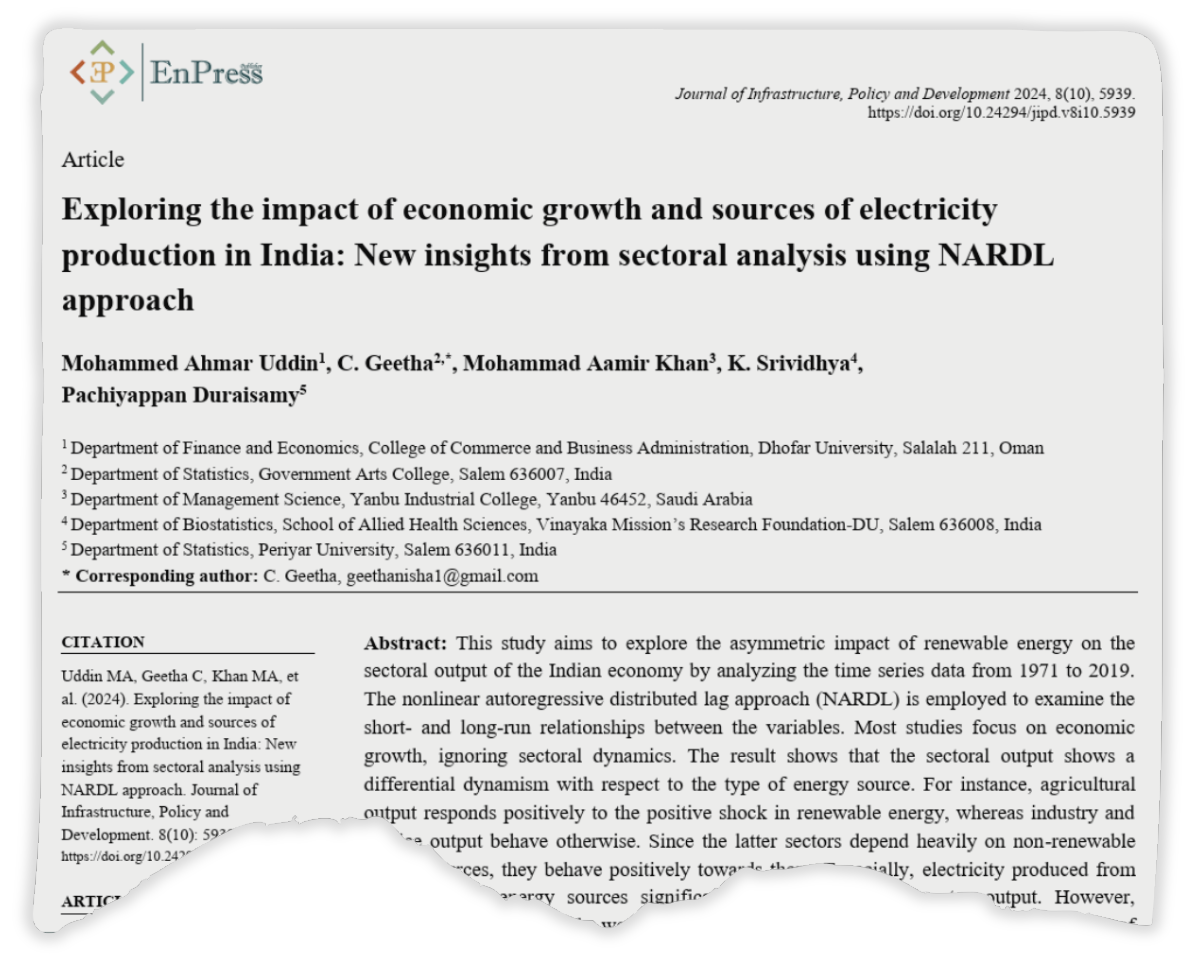
In April 2024 – three months after S had submitted her paper to the Springer Nature journal – someone submitted the study to EnPress Publisher’s Journal of Infrastructure, Policy and Development (JIPD). It was published in September 2024, listing authors based at institutions in Oman, India, and Saudi Arabia. As Retraction Watch and others have reported, unlikely co-authorship networks can indicate the activity of paper mills, which churn out subpar or plagiarized studies, sell authorship slots, and artificially inflate citations.
In January 2025, Scopus stopped indexing JIPD. Some observers have suggested that may be because the journal has recently had a sudden surge in the number of papers it is publishing — often seen as a sign of lowering standards for publication.
S didn’t know that the JIPD paper presenting her work had gone live until she resubmitted her paper to a different journal. The editor there rejected it, noting that it had too many similarities to the JIPD paper.
After being pointed to the publication, S went through the whole article line by line and realised that every single data point she had used, all the literature she referenced, and the citations she included were the same. “This is not their paper at all,” she said. “This is my paper, which I have written without anybody’s help.”
S is now calling for the JIPD paper to be retracted. We reached out to one of JIPD’s associate editors, Jun Xie, who is the president of the Asian Digital Development Bank and president of the Asia-Pacific Investment Development Bank, for a comment but didn’t hear back.
Mohammed Ahmar Uddin of Dhofar University in Salalah, Oman, who is listed as the first author on the JIPD paper, told us the study was checked for plagiarism before publication.
“The data used in the research were publicly available from government sources,” Uddin said. “Furthermore, several published research studies are already available related to this topic and our research was aimed at providing additional insights. Upon receiving the complaint I have also written to the journal and [am] awaiting their reply.”
In an interview with us, Uddin denied that he bought an authorship slot on the paper or being in touch with any paper mill. Uddin said he doesn’t know any of the listed coauthors and was introduced to them via a mutual researcher contact.
“On my part, I assure you that I am capable enough and would never consider publishing a paper by dubious means,” he added.
The man who discovered that S’s paper was probably sold on Telegram knew about paper mills because he had had personal experience with one. Ashutosh Tiwari, who runs the counseling firm Mindglass WellBeing, told us that after he saw S’s post about her study having been stolen, he searched keywords from the JIPD paper on Telegram and found a matching advertisement dated December 29. Authorship slots had been sold for 15,000 Indian rupees (INR; around $165) for first author, 10,000 INR ($110) for second author, and 5,000 INR ($55) for the remaining slots, Tiwari said.
Tiwari knew about the inner workings of paper mills because he had previously himself used the services of such a shady service without realising it was unethical. Although the paper Tiwari ultimately published was his own, he paid 10,000 INR with the hope of receiving help in publishing quickly in a journal indexed by Scopus.
“I was not guided in the family, in my friend circle, [on] how to write, [or] how to submit,” he said. Tiwari ultimately retracted that study and republished it after revisions in a different journal. “That was a fast process because I requested them that it is a matter of my Ph.D.,” he said.
Update, January 27, 2026: The authorship ad on Telegram listed the second author fee as 10,000 INR, not 15,000, as previously stated.
Like Retraction Watch? You can make a tax-deductible contribution to support our work, follow us on X or Bluesky, like us on Facebook, follow us on LinkedIn, add us to your RSS reader, or subscribe to our daily digest. If you find a retraction that’s not in our database, you can let us know here. For comments or feedback, email us at [email protected].
The LinkedIn profile for Ashtash Tiwari linked above includes this under Education:
“GNDU
PhD* PSYCHOLOGY
Activities and societies: PhD submission denied after I refused to let Dr Sunita Gupta and UGC Ex Secretary Jaspal Sandhu Look at my bank passbook.”
Authorship slots had been sold for 15,000 Indian rupees (INR; around $165) for first author, 15,000 INR ($110) for second author, and 5,000 INR ($55) for the remaining slots, Tiwari said.
10,000 INR?? Typo? (Can delete after fix.)
Ah – yes indeed. The article has been corrected. Thank you!
“Mohammed Ahmar Uddin of Dhofar University in Salalah, Oman, who is listed as the first author on the JIPD paper, ….. said he doesn’t know any of the listed coauthors and was introduced to them via a mutual researcher contact.”
Is it common in that field for the first author of a paper not to know any of his/her coauthors????
In India, one very practice that if some one get opportunity to visit abroad, ( by hook & crook or any means once or twice,interestingly thereafter they are never asked by any foreign institute) feel elated and even put herself/ himself as if they are bigger scientist or researcher ,not only that they are put on very high esteemed place by the system and society while practicing these kind of dubious research.
So they buy a paper from a paper mill, and then find out it is actually a copy of someone else’s unpublished paper. There is definitely no honour among thieves. I wonder if they got their money back.
interesting link..
I have an article publish by scopus journal in the country.. I will always the link of journal and publisher…
Every day there are many published studies without added values just for publications.
Try to make something which might make a difference.