At wit’s end after a publisher ignored her repeated requests for a correction, Ursula Bellut-Staeck took the extreme step of issuing her own retraction. But is that even a thing?
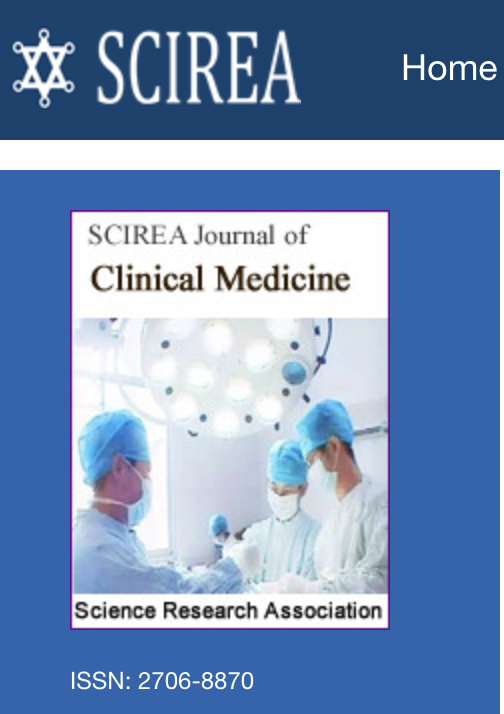
Bellut-Staeck, an independent researcher from Berlin, Germany, submitted a paper to SCIREA Journal of Clinical Medicine last spring after receiving an invitation from the journal. The article, about mechanotransduction and the impact of infrasound and vibrations, was published June 16.
But when Bellut-Staeck realized her affiliation as listed on the article needed changing, she contacted the journal to request a correction. The problem, she said, was linguistic. Because she didn’t realize “affiliation” has a different meaning in German than English, she had mistakenly listed herself as being at an institution she has since left.
Receiving no response to three correction requests, she finally asked the journal to retract the paper. Frustrated when she still didn’t hear back, Bellut-Staeck said, she performed an “unilateral author-initiated retraction” on November 27.
She documented the self-retraction on Figshare, writing she “unilaterally retracts” the article for “persistent non-responsiveness of the publisher for more than five weeks to repeated legitimate requests for correction of a critical affiliation error” and for “evidence of absence of meaningful peer review.”
“Since its publication on June 16, 2025, the behavior of the editors of the Journal of Clinical Medicine has been a major source of stress,” Bellut-Staeck told us in an email. “In any case, it damaged my credibility during this period, which I was only able to restore by unilaterally retracting a scientific article that had been the result of a great deal of work.” She believes the self-retraction “fully complies with COPE Retraction Guidelines for cases of publisher non-responsiveness and predatory practices.”
Published online by SCIREA – which publishes 25 journals in total – the Journal of Clinical Medicine is not a COPE member. On its website, the journal calls itself an “international, scientific peer-reviewed open access journal” that provides “rapid publication” and “high visibility.” The journal boasts being “indexed in the Google Scholar and other databases.” It is not indexed in Clarivate’s Web of Science, but MDPI’s identically named Journal of Clinical Medicine is.
While Bellut-Staeck says she’s following COPE’s guidelines in her unusual move, in fact those standards do not address self-retraction in cases of non-responsive publishers. The guidelines state authors who become aware of potential errors, ethical issues or misconduct must raise these issues to the journal’s editor and with the institution, but that “the decision to correct or retract an article is made by the editor.”
“There is no such thing as ‘self-retract,’” said Jodi Schneider, an associate professor at the University of Wisconsin-Madison who specializes in information quality, biomedical informatics and controversies in science.
If the journal is a COPE member and is not responding to correspondence, authors can reach out to the group to issue a complaint, Schneider said. If the journal is not a COPE member, authors can check whether they participate in other professional associations that might take an interest.
“If professional organizations and DOI registrars cannot help, the author does not have any obvious remedies,” she told us.
Bellut-Staeck detailed for Retraction Watch the extraordinary path her paper took her down. She originally submitted it to another journal, she said, where it was rejected. Around the same time, she received the submission invitation from SCIREA Journal of Clinical Medicine. She reviewed the journal’s profile, but “apparently not thoroughly enough,” she said.
After many failed attempts to reach the publisher about the correction, and before resorting to posting her own retraction notice, Bellut-Staeck had an idea. She transmitted a new “submission” through the journal’s submission portal. Instead of sending an article, she sent a request to contact her about the correction.
After nine days, the “submission” was accepted as if it were an article, according to Bellut-Staeck and correspondence we have seen. She then received a payment request for $460. When she didn’t respond, the journal sent a second, discounted offer of publication for $99.
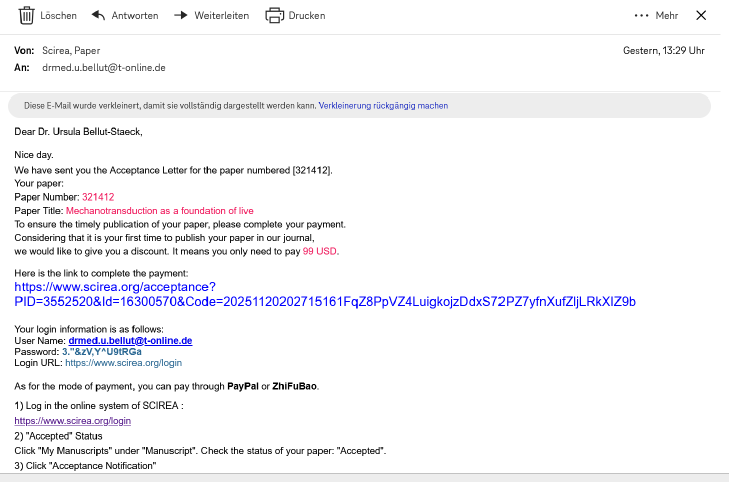
“For me, this meant that the publisher had finally crossed a red line, and it strengthened my resolve to unilaterally withdraw the work,” she told us.
The publisher eventually corrected the affiliation error without communicating with Bellut-Staeck, she said. However, the researcher still wants a retraction because she has ethical concerns with the journal now and wants to protect her credibility.
Apart from the affiliation issue, Bellut-Staeck said the content of her paper is scientifically correct and remains fully valid. She hopes to reintegrate the important results of her work into a new publication.
In an attempt to get the journal’s side of the story, we sent emails to the four email addresses listed on SCIREA’s Journal of Clinical Medicine’s contact page. Two of the messages were undeliverable because the addresses could not be found. No one responded from the other two.
The journal has no editor-in-chief listed on its website, and no one named as a contact for the publication. The site does list more than 90 members on its editorial board from institutions across the world. Few board members returned messages by Retraction Watch seeking comment, and those who did respond said they were not affiliated with the journal.
Cancer researcher Bene Akromaa Ekine-Afolabi, for example, told us she is not a member of the board and only learned she is on the journal’s website when we contacted her. Ekine-Afolabi is listed as affiliated with an institution at which she had a role 15 years ago, the University of East London School of Health, Sport and Bioscience. She has since contacted the journal, asking it to remove her name.
Cardiologist Nassir Azimi also told us he’s not affiliated with the journal. He learned he is included on the journal’s purported board when we contacted him.
When it comes to routes for researchers unhappy with a publisher’s response – or lack thereof – authors can always formally update their views on an earlier work and try to bring attention to the changes. Authors can, for instance, write or share a new document online or in an editorial, said Schneider. But the updates can be challenging to publicize.
“These commentaries about a publication — whether in an online post or an editorial — can be difficult to find unless the original publisher makes similar links,” she said. “Readers would have to search specifically for such documents.”
Like Retraction Watch? You can make a tax-deductible contribution to support our work, follow us on X or Bluesky, like us on Facebook, follow us on LinkedIn, add us to your RSS reader, or subscribe to our daily digest. If you find a retraction that’s not in our database, you can let us know here. For comments or feedback, email us at [email protected].
The author published a very similar paper in 2023. https://doi.org/10.4236/jbm.2023.116003
Am I crazy or does this paper remind anyone of Moses. T Bility’s “The Earth’s magnetic field causes COVID and Jade amulets will protect you” papers?