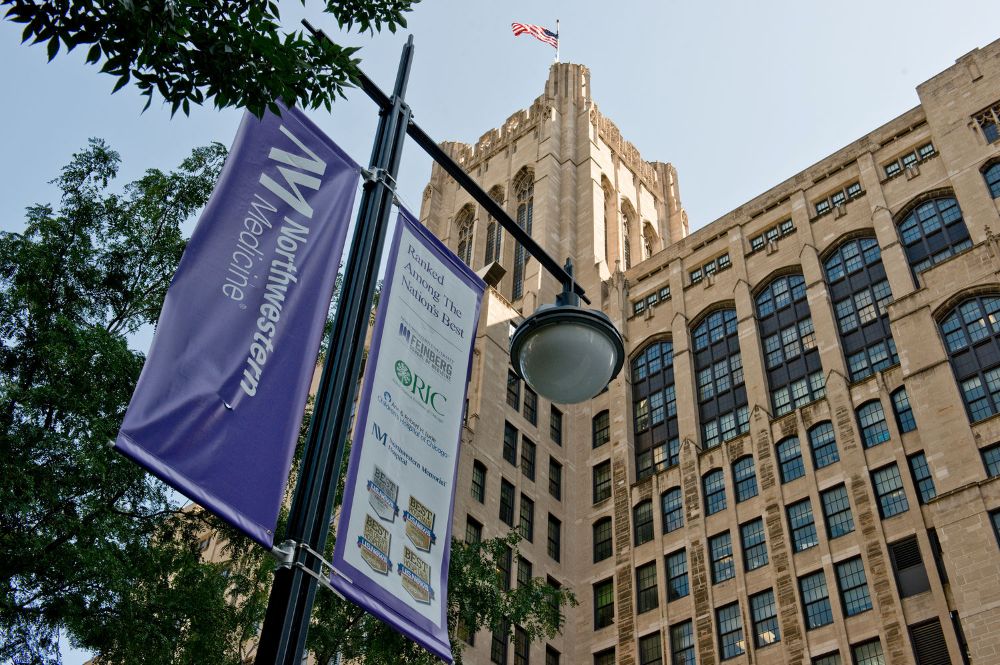
A researcher accused of falsifying research in work funded by the National Institutes of Health has cost Northwestern University $2.3 million.
The university, based in Evanston, Ill., violated the Civil Monetary Penalties Law when a former researcher at the school falsified work funded by an NIH award, according to a November press release from the U.S. Department of Health & Human Services’ Office of Inspector General. The researcher and other investigators then referenced the falsified research in grant applications, reports and other submissions to NIH for two other awards, according to OIG. Together, the three grants totaled about $5 million, with $3.5 million tied to Northwestern.
The Civil Monetary Penalties law allows OIG to impose penalties against individuals and entities that engage in fraud and other improper conduct related to government grants. OIG learned of the researcher’s manipulation when Northwestern self-disclosed the conduct, the release said.
Northwestern did not respond to multiple messages seeking comment.
Jing Liu, who now works at the University of Illinois Cancer Center, is the principal investigator named on the three grants. She did not return messages seeking comment.
Liu worked at Northwestern from at least 2008 to 2018, according to grant records. Her research was frequently showcased in news stories at Northwestern, and in 2024, she was awarded the Lung Cancer Research Award by the Respiratory Health Association.
The HHS OIG declined to provide further details about the case beyond the press release. However, the agency emphasized the importance of self-disclosing misconduct associated with government funds.
“[W]e encourage all grant recipients to self-disclose any improper use of HHS funds through our Grant Self Disclosure Protocol,” spokesperson Melissa Rumley told Retraction Watch. “Through that protocol, OIG provides incentives for recipients to come forward and make the government whole.”
At least one retraction seems to have resulted from the research falsification. In January 2025, Nature Immunology retracted a 2013 paper about the gene regulator Miz1 and its effects on inflammation and acute lung injury. The retraction notice says:
An investigation conducted by Northwestern University stated that the corresponding author failed to produce a complete and accurate data set, and concluded that falsified data was produced to support research in this publication.
Liu is the corresponding author on the paper, which Northwestern highlighted in a 2013 news story that also mentioned the NIH grant. In the article, Liu discussed the novelty of the work.
“It has been reported that it [Miz1] plays a part in embryonic development, the cell cycle, and cell death,” she is quoted as saying. “Although we are the first group to demonstrate that this molecule plays a role in inflammation, we would like to see what other functions it is responsible for.”
Coauthors of the study contacted by email and LinkedIn did not return messages seeking comment.
The retraction notices states seven of the 16 coauthors, including Liu, disagreed with the retraction, and one author agreed to it.
Northwestern is one of two major research institutions recently penalized by the government following claims of research misconduct. In December, the Department of Justice announced that Dana-Farber Cancer Institute had settled a lawsuit under the False Claims Act, admitting researchers used images and data that were “misrepresented and/or duplicated” in support of grant applications to NIH. Dana-Farber agreed to pay $15 million to settle the claim.
The Northwestern case did not rise to the level of the False Claims Act, likely because it was disclosed early, said J. Michael Slocum, an attorney with Slocum & Boddie PLLC. based in Alexandria, Va., who specializes in clinical and research contracts, grants and research ethics. (Slocum was not involved in the Northwestern case.)
Generally, when HHS learns of such cases, the agency doesn’t automatically refer them to the DOJ unless it is concerned about “really blatant criminal activity,” Slocum said.
“The takeaway is, if you want to avoid the False Claims Act and all of the severe penalties that come with it, one of the best ways is to be as proactive as possible, catch bad situations before they get to the point of being referred to the Department of Justice, and deal with them with the administrative agencies as quickly and as internally as possible,” Slocum told us. “The system is set up for self-policing. Nobody can guarantee that something won’t happen to get you [involved] in the False Claims Act, but the chances go way down when you’re proactive.”
Cases that stay at the administrative level also typically stay quieter, with fewer details available, Slocum added. The OIG press release on the Northwestern case is three sentences long.
With DOJ cases, “it’s much more public. You’re going to get a full delineation of what went on, particularly with this administration,” he said. “This is a fraught time period for universities, and keeping it at that institutional level, for dollar reasons and for reputational reasons, it’s much better to have done it that way.”
Like Retraction Watch? You can make a tax-deductible contribution to support our work, follow us on X or Bluesky, like us on Facebook, follow us on LinkedIn, add us to your RSS reader, or subscribe to our daily digest. If you find a retraction that’s not in our database, you can let us know here. For comments or feedback, email us at [email protected].
That’s not much
“Generally, when HHS learns of such cases, the agency doesn’t automatically refer them to the DOJ unless it is concerned about “really blatant criminal activity,” Slocum said.”
NIH tolerance of fraud and FCA violations is well deserved with published court cases like demonstrating a tendency to protect fraud. Especially by fraudsters inside NIH like Masliah [Athira case for eg].