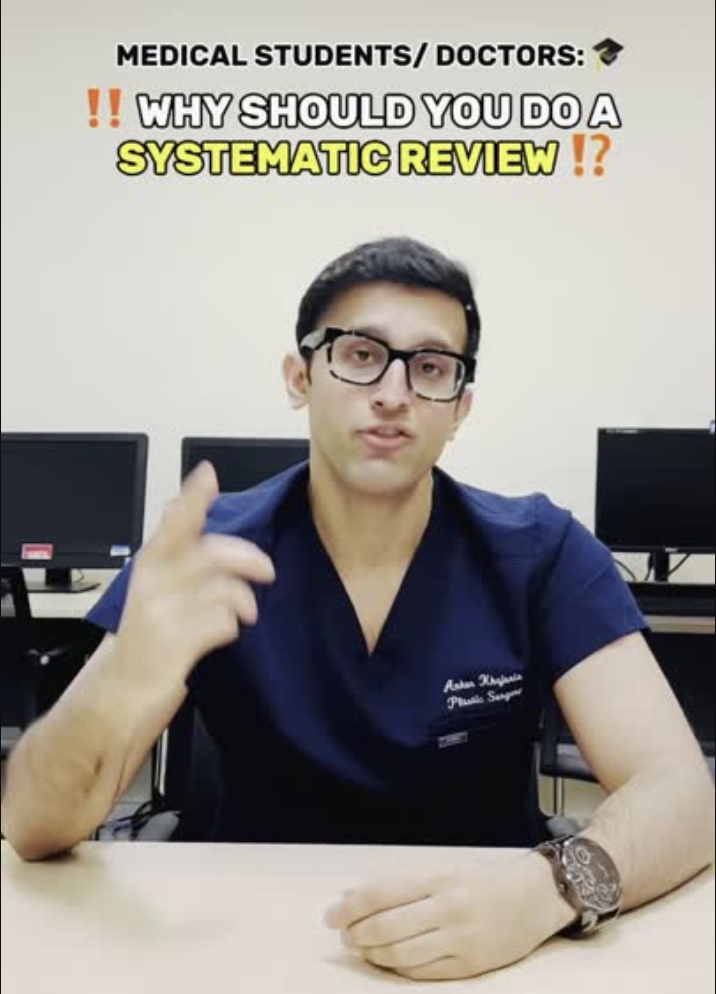
“Research will help you get ahead,” British surgeon Ankur Khajuria told his 16,000 followers in a 2024 Instagram post while seated in scrubs embroidered with his name. “If you want to learn about publishing, check out the research academy at HighYieldUK.com.”
The company, which offers medical students mentoring in publication, isn’t the only commercial venture for Khajuria, a plastic and reconstructive surgeon in his mid-thirties active in the media, including as a contestant on Squid Game: The Challenge. His entrepreneurship has extended into medical device manufacturing under the banner of Avance Innovations, which he founded and where he is CEO. For his professional efforts, Khajuria has been given a prestigious award and high praise from his colleagues, with one calling him “brilliant.”
But an investigation by Retraction Watch reveals a different view. Khajuria’s academy raises concerns about promises of publication for a price, and his prolific publication record has set off flags on PubPeer, where commenters have raised allegations of plagiarism. And Avance Innovation’s signature surgical device, while marketed for humans, has apparently been tested on only six rats and no people. Close examination by the Medical Evidence Project, an endeavor of The Center for Scientific Integrity (publisher of Retraction Watch), indicates the data in that rat study lack internal consistency, making them questionable.
Khajuria did not respond to multiple requests for comment sent to his email and social-media accounts. However, some claims made by his companies were changed following our inquiries.
Guaranteed publications, at a price
Born in India, Khajuria has described moving to the United Kingdom at the age of 11 without speaking a word of English. After attending the exclusive Wellingborough School in Northamptonshire, he amassed an impressive string of credentials: a medical degree from Imperial College London, a master’s in Surgical Science and Practice from the University of Oxford, and a Ph.D. from the University of Portsmouth. The last institution awarded him the degree based on publications he had already completed.
He now signs his name: “Dr Ankur Khajuria, BSc (Hons) MBBS (Dist.) AICSM FHEA FRSPH MRCS (Eng) MAcadMEd. MFSTEd. MSc (Oxon) PhD.”
Khajuria promotes High Yield UK as a way for students to follow in his footsteps of success. Billed as a “Systematic Review and Meta-Analysis Masterclass,” the company has guaranteed medical students and junior doctors a peer-reviewed paper for £898, according to archived promotional materials.
Some customers have given High Yield UK high marks.
“This has been the best investment into my professional/academic endeavours thus far,” a medical student named Kian Daneshi wrote in his Trust Pilot review of High Yield UKs “research fellowship” last year, a review that has since been removed. “I managed to work on 10 projects in total, with 5 guaranteed 1st/co1st authorships.”
But our reporting on commercial publication-guarantees has raised concerns about the ethics of the trade. The practice is sometimes employed by for-profit paper mills. A review of Khajuria’s own prodigious output – he boasts more than 100 publications and book chapters in the last decade – shows he typically writes papers with teams of students in conjunction with one other more established author. At least five of Khajuria’s publications show apparent plagiarism, text recycling, or statistical irregularities, according to commenters on PubPeer.
Two of Daneshi’s papers with Khajuria have significant overlap in their text, as noted by an anonymous commenter on PubPeer.
“The text similarity is most marked in the conclusions which only differ by 7/112 words,” the commenter observed. “The conclusions are presented as independent scientific findings yet differ only by changing the procedure name and a few others.” (Daneshi did not respond to a request for comment.)
Khajuria hasn’t addressed these issues as he has turned even minor publishing milestones into life lessons for his followers.
“Thrilled for my recent acceptance in The Lancet, with an impact factor of 202.7,” he wrote on LinkedIn in 2023. This “acceptance” was of a three-paragraph letter to the editor, but for Khajuria it became another teachable moment.
“If you’re a medical student or doctor striving to achieve similar success, I encourage you to stay committed to your goals and continue sharpening your skills,” he added. “A great way to do this is by exploring resources like the research courses offered by highyielduk.com.”
His peers have praised his work.
“He is one of the most brilliant surgeons in terms of scientific work that I know,” said Alfredo Hoyos, an editor at Plastic and Reconstructive Surgery who has collaborated with him. Hoyos coauthored a bibliometric analysis with Khajuria and Daneshi, which found that “outcomes” and “complications” were important themes in research on Brazilian butt lifts.
Promoting a surgical device for humans, tested only on rats
Hoyos told us he helped Khajuria revise his published study of Avance Innovation’s signature product: the ORASIS device. Developed by Khajuria and billed as “the future of vascular anastomosis surgery,” the 3-D printed wafer promised to help surgeons join blood vessels faster, safer and more easily than ever before by using microfluidic channels to draw blood away from a surgical site, keeping the area clear for suturing.
The device won the 2024 Cutler’s Surgical Prize from the Royal College of Surgeons in England and was a runner-up in the American Society of Plastic Surgeons’ Innovation Challenge. According to promotional materials, the “FDA-registered” device could “reduce operative time by 30 percent” and yield “potential cost savings over $1B in the U.S. market alone.”
But a newly released forensic analysis by the Medical Evidence Project of the only published study supporting those statements found the study’s statistical results could not be reproduced. The 2024 study in question, published in Plastic and Reconstructive Surgery, involved six rats and no human subjects. It compared the time required for experienced surgeons to suture animals’ femoral arteries with and without the device.
In the paper, the authors reported a 21 percent reduction in procedure time — not 30 percent of the total operative time as claimed by Avance — yet even that modest improvement remains uncertain.
James Heathers, director of the Medical Evidence Project, said when he and David Grimes, a Retraction Watch Sleuth in Residence, checked the data for internal consistencies using a newly developed technique, “The p values from the primary results were either inconsistent or impossible, and some of the secondary results were not reproducible.”
Gabriel Crone, a graduate student researching statistical problems in psychology at York University in Toronto, who has previously published on Heathers’ methodologies, said he agrees the anomalies uncovered by the Medical Evidence Project report are “somewhat concerning.” But without more information on how the original statistical tests were run, or access to the raw data, Crone added, it’s not possible to determine the cause of the anomalies.
Josh Destafano, a spokesperson for Wolters Kluwer, which publishes Plastic and Reconstructive Surgery, says that it does not comment on specific authors and their research, but noted that “if one of our journals receives an indication that there has been wrongdoing to manipulate research, we review that inquiry based off of COPE guidelines.” The Royal College of Surgeons of England did not respond to a request for comment.
Avance previously posted testimonials to ORASIS from anonymous surgeons and offered instructions for purchasing the device on its website, saying the device has been “FDA-registered.” Device registration is generally required if a manufacturer plans to produce or distribute a medical device in the U.S.
Late last year, following our inquiries, a disclaimer was added to the website that read, “All product information provided on this site is for general informational purposes only and does not constitute marketing, promotion, or sale of the device.” The website has since gone offline.
Like Retraction Watch? You can make a tax-deductible contribution to support our work, follow us on X or Bluesky, like us on Facebook, follow us on LinkedIn, add us to your RSS reader, or subscribe to our daily digest. If you find a retraction that’s not in our database, you can let us know here. For comments or feedback, email us at [email protected].
I can’t find any FDA registration for Avance Innovation or the ORASIS device. Perhaps somebody else can?
https://www.accessdata.fda.gov/scripts/cdrh/cfdocs/cfRL/rl.cfm
UK junior doctors earn about GBP 40k/year and have about GBP 100k/debt (on average). Should we be surprised that some of them are turning to commercial enterprises like this to supplement their incomes.
Another Macchiarini on the make
Exactly! I got a Macchiarini vibe as well: an aura of genius (based on…?) with a device/approach without proper scientific evidence
Excessive self-promotion is always concerning
Shocking lack of research ethics bringing the profession into disrepute. I hope the GMC are involved and his training deanery
Also: Meta-Analysis Academy run by
Rhanderson Cardoso MD with 11000 followers on instagram.
https://beacons.ai/rhandersoncardoso