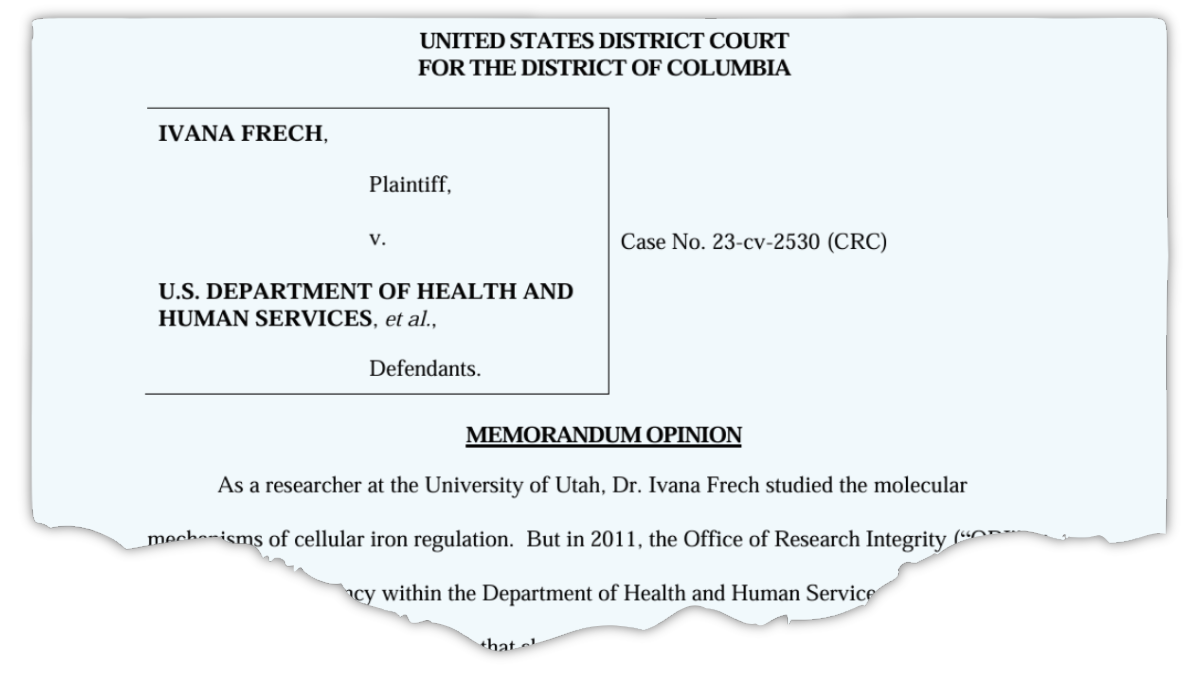
A federal court has terminated a former researcher’s lawsuit against the U.S. government agency that barred her from receiving federal funds following an agency investigation that lasted 10 years.
Ivana Frech — formerly Ivana De Domenico — sued the U.S. Office of Research Integrity (ORI) in 2023 after the agency concluded she engaged in research misconduct while at the University of Utah, by “intentionally, knowingly, or recklessly falsifying and/or fabricating” images in work funded by the National Institutes of Health. In her legal complaint filed shortly after ORI’s debarment, Frech alleged the agency’s misconduct findings and debarment decision were “arbitrary, capricious, an abuse of discretion, unsupported by substantial evidence, and contrary to law and regulation.”
On December 12, the U.S. District Court for the District of Columbia threw out Frech’s suit, ruling in favor of the government’s motion for summary judgement. Summary motions are granted when a court finds no genuine dispute over material facts and a lack of conflicting evidence for a jury to weigh. The decision allows ORI’s three-year debarment – which runs through August 2026 – and misconduct conclusions against Frech to stand.
Frech told Retraction Watch she was disappointed with the outcome, but that she respected the court’s decision.
“Although it was not the result I had hoped for, I am pleased that the Court specifically noted that its decision should not be understood as the Court’s agreement with HHS’ actions or that the ten-year delay in issuing its debarment decision was justified,” Frech told us in an email statement sent by her attorney, Stephen Tobin.

“Moreover, I am appreciative that the Court expressly noted that it had no doubts about my ability to meaningfully contribute to the scientific community in the future.”
Frech declined to answer further questions about the case. ORI did not respond to a request for comment.
The case dates back to 2011 when ORI received allegations that Frech manipulated data underlying a series of research papers on which she was a coauthor. The agency referred the allegations to the University of Utah, where an investigation uncovered a “pattern of recklessness” in how Frech reported data across multiple publications, according to the court’s December 12 summary of the case. In 2012, Cell Metabolism retracted two papers associated with the manipulated data at the request of the authors. More corrections soon followed.
The university concluded Frech had committed research misconduct, terminated her employment, and sent its findings to ORI.
In 2014, Frech informed the agency she “vigorously opposed the accusations made against her” and continued to maintain her accusers were incorrect and “motivated by bad faith,” according to the court’s summary. She asked to present additional arguments and evidence in her favor if the office conducted an oversight review.
In 2017, ORI extended a settlement offer to Frech that if accepted, would allow her to receive supervision and education in lieu of debarment. She declined the settlement, according to court records.
In July 2023, a decade after ORI’s investigation began, ORI ruled Frech had engaged in research misconduct and barred her from receiving federal funds for three years. Attorneys for Frech asked ORI to “reconsider its decision not to resolve the matter through a mutually agreeable settlement.”
However, on August 29, 2023, ORI informed Frech that because she failed to request an administrative hearing within 30 days of the charge letter, the debarment was final. Frech then sued, claiming the misconduct findings and final decision violated the Administrative Procedure Act, a federal law governing how agencies make rules and resolve disputes.
As part of the litigation, Frech requested a temporary restraining order to block ORI from enforcing the debarment. At the time, Frech’s new employer, a community hospital in Iowa City, had been purchased by the University of Iowa, which does not employ debarred employees, according to court records. Because of the debarment, Frech was terminated from her job on January 30, 2024, according to her motion for the restraining order.
Frech’s motion was denied, but the court cautioned that ORI “may have a bit more explaining to do,” according to a summary in the December 12 decision.
The court highlighted three potential shortcomings in ORI’s explanation for its debarment decision: “a lack of detail in the justification of its conclusion that Frech was personally responsible for an altered figure in one of the articles … a failure to grapple with Frech’s argument that the passage of time since the alleged misconduct mitigated any concern that she was not presently responsible, and … a failure to explain its determination that Frech solely planned, [initiated], and carried out the wrongdoing.”
In response, the government asked the court to remand the case to HHS so the department could reexamine the agency’s actions. In November 2024, ORI again concluded that Frech “engaged in research misconduct and recommended a three-year debarment period.”
In the court’s latest 27-page decision, District Judge Christopher R. Cooper concluded found Frech’s debarment was not “arbitrary, capricious, an abuse of discretion, or otherwise not in accordance with the law.”
“The department addressed the court’s concerns, articulated ‘a rational connection between the facts found and the choice made,’ provided ‘substantial evidence’ supporting its decision, and made no ‘clear error in judgment,’” Cooper wrote.
According to the court, ORI explained the long delay for its ruling was due to “the large and growing volume of ORI’s responsibilities relative to its staffing levels.”
The court also addressed Frech’s contention that in the years since she left the University of Utah, her “positive impact and unblemished record” at another laboratory demonstrates that she is presently responsible. Following her termination at the university, Frech stepped away from science and obtained her MBA, according to the court’s summary. In 2015, she accepted a position as a research scientist in Fenghuang Zhan’s laboratory at the University of Iowa.
Frech attested that during her four years at the lab, no one raised concerns about “the veracity or accuracy of her work,” nor were there any questions about her “professionalism and integrity.” However, in its amended charge letter, ORI identified several instances in which Frech was purportedly not “transparent about her involvement with federally funded research while working in the Zhan laboratory.”
Although Frech “vigorously” disputed the assertion, Cooper wrote she is ultimately asking the Court to reweigh a mitigating factor that ORI already considered. Agree or disagree, the determination was “the product of reasoned decisionmaking and therefore ‘must be upheld’ under the deferential APA standard of review,” the judge wrote.
But Cooper made clear that the court “is not stating that it would have reached the same conclusion as the Debarring Official,” nor is the court justifying the department’s “ten-year delay in issuing its debarment decision.”
“And the court does not doubt that Dr. Frech may make meaningful contributions to the scientific community in the future,” Cooper continued. “Instead, the court simply adheres to the ‘highly deferential’ standard of review under the APA.”
Meanwhile, another paper highlighted in ORI’s investigation is still intact, despite a recommendation that it be retracted. Editors of Developmental Cell did not return messages seeking the status of the recommended retraction. Jerry Kaplan, professor emeritus at the University of Utah and a coauthor of the paper, told Retraction Watch that to his knowledge, the University of Utah has been in communication with the journal regarding the issue. He said he was not aware of a resolution in the matter.
Like Retraction Watch? You can make a tax-deductible contribution to support our work, follow us on X or Bluesky, like us on Facebook, follow us on LinkedIn, add us to your RSS reader, or subscribe to our daily digest. If you find a retraction that’s not in our database, you can let us know here. For comments or feedback, email us at [email protected].
https://www.pubpeer.com/search?q=Fenghuang+Zhan
Fenghuang Zhan has 10 papers flagged on PubPeer, including some from the period when Dr Frech/De Domenico was associated with his lab.