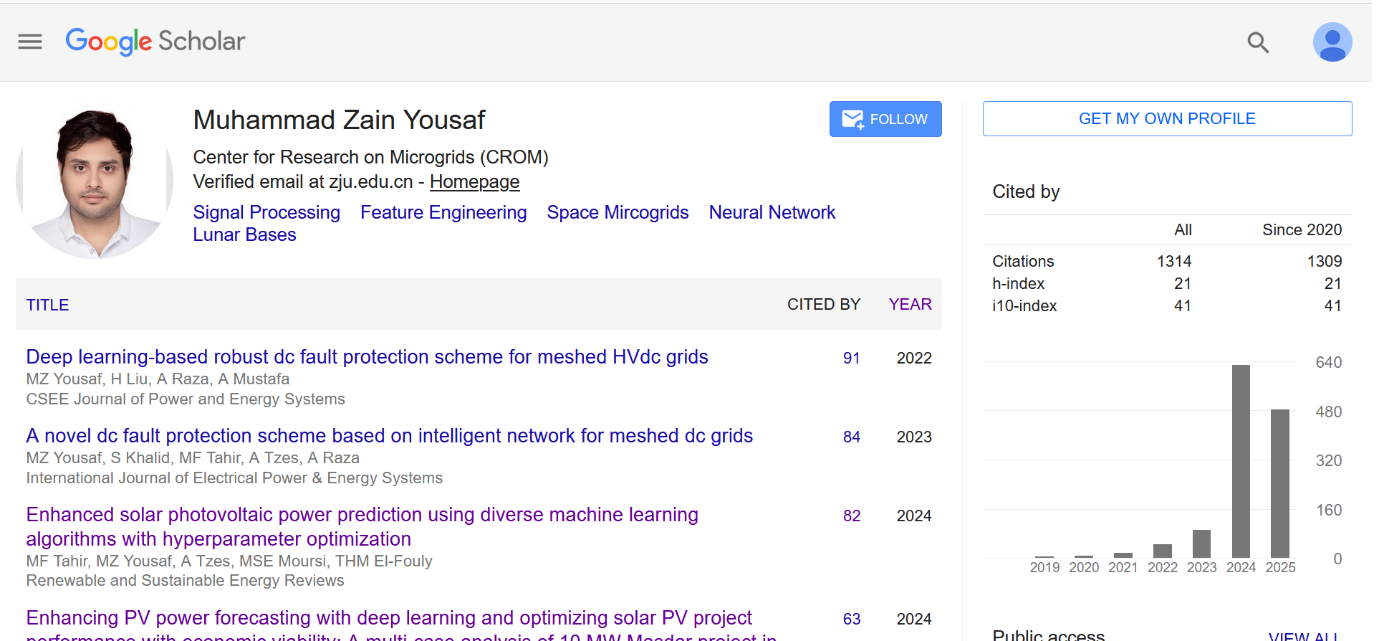
Muhammad Zain Yousaf, a postdoc at Zhejiang University in Hangzhou, China, became a scholar of note overnight. Or so it would seem, based on his now-defunct Google Scholar profile: From a modest 47 in 2022 and around 100 in 2023, Yousaf’s citations jumped to 629 in 2024. His h-index, a measure combining publication and citation numbers, took off accordingly, reaching levels typical of a senior academic.
But another researcher smelled a rat and took a closer look at Yousaf’s publications. In just two days, Yousaf had uploaded 10 short documents to TechRxiv, a preprint server hosted by the U.S.-based Institute of Electrical and Electronic Engineers, or IEEE. Each of the documents was chock-full of self-citations. In five cases, Yousaf was an author on all 37 papers in the reference list; the rest of the time, his publications made up nearly two-thirds of the reference list.
“Many of these documents appear to be low quality, as evidenced by their lack of coherence and technical quality,” the concerned researcher, who asked to remain anonymous, said of the preprints in an email to TechRxiv last December.
The researcher added that Yousaf’s actions were “a clear attempt to manipulate citation metrics on external platforms such as Google Scholar” and “undermine the credibility of TechRxiv as a platform for genuine academic contributions.”
One year later all of the documents remain on IEEE’s server. “IEEE is aware of the concerns regarding these papers and is investigating,” Francine Tardo, corporate spokesperson for the organization, told us.
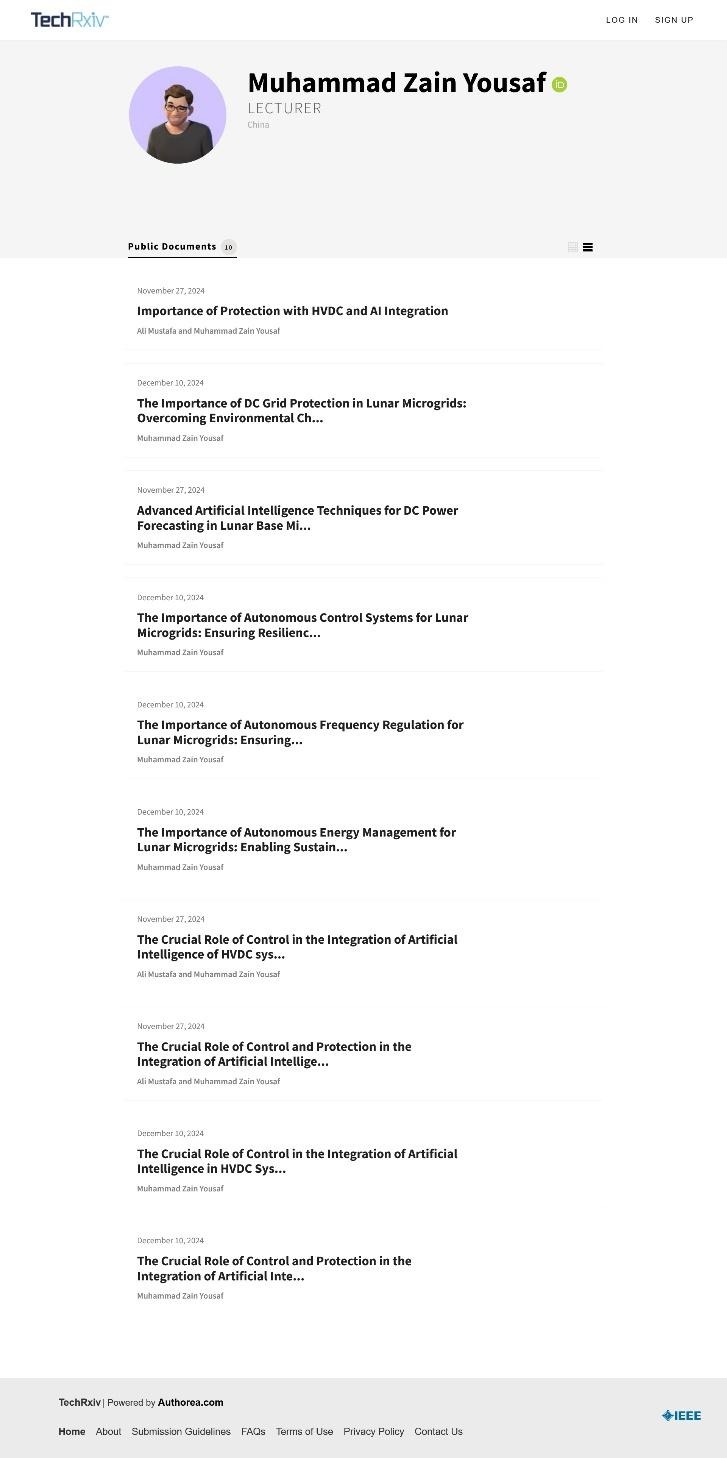
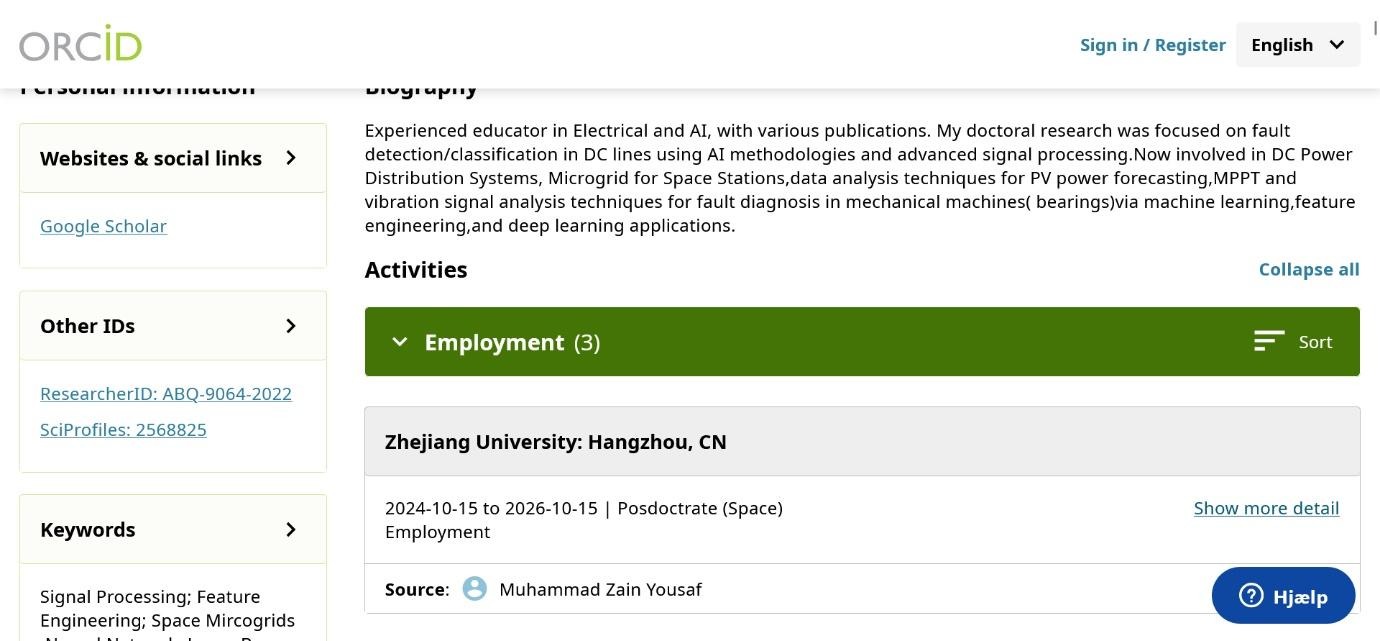
Yousaf, an electrical engineer, did not acknowledge our emails laying out the allegations against him and asking for an interview. But on the day we first contacted him, the researcher’s Google Scholar page, which listed his h-index as 21, was taken down; his name on TechRxiv was shortened to “Yousaf” and delinked from his ORCID profile; and the ORCID entry describing his current position at Zhejiang University – “Posdoctrate (Space)” (sic) – disappeared. Several more entries were removed later. A recent paper lists Yousaf’s affiliations as the School of Aeronautics and Astronautics at Zhejiang University and the Center for Research on Microgrids (CROM) at Huanjiang Laboratory in Zhuji.
Google Scholar has become the go-to source of publication metrics for academics evaluating new job applicants, even at renowned universities in the United States and England. But the tool is exceedingly easy to game for those looking for a shortcut to impressive numbers – the service will index even non-existent papers cited in preprints – as researchers have shown again and again (and again and again and again). We wrote about a high-profile computer scientist in Spain, Juan Manuel Corchado, who had done just that in 2022.
To get a better sense of how this tactic inflated the researcher’s h-index, David Robert Grimes, one of Retraction Watch’s Sleuths in Residence, scraped data from Google Scholar on September 10, when Yousaf’s h-index was 19. Excluding self-citations slashed the index to 13, and removing sources with no or minimal peer review, such as preprints and conference proceedings, brought it down to 12. When Grimes excluded both self-citation and sources without peer review, Yousaf’s h-index dropped to 9, a reduction of more than 50 percent. (Yousaf’s h-index according to Scopus, the Elsevier citation database, is 14, up from 13 in November.)
“This is far from the first time somebody has used non-peer-reviewed archives to manipulate Google Scholar,” said Reese Richardson of Northwestern University, who studies scientific fraud. “Google Scholar has made it very clear they don’t intend to fix this. They have known about this for 10 years.”
Google did not respond to requests for comment.
Yasir Zaki, a computer scientist at New York University Abu Dhabi in the United Arab Emirates, recently published a study describing different ways Google Scholar metrics can be manipulated. Yousaf’s case, Zaki said, is “in line with what we have seen in the past.”
“Many of our suspicious authors were uploading documents to either ResearchGate or Authorea,” Zaki told us. “On a related note, arXiv has banned computer-science review papers that have not been published for the exact same reason, because some authors are using this as a way to inflate their citations.”
Zaki said he and his colleagues built a tool using data from OpenAlex to visualize collaboration patterns for specific researchers. The tool shows Yousaf had nearly 130 unique coauthors with whom he collaborated only once, and that in 2025, Yousaf had as many as 120 new unique coauthors – both abnormally high numbers, according to Zaki.
Graham Kendall, a computer scientist and deputy vice chancellor at Mila University in Malaysia who writes frequently about publications ethics, also noted a steep rise in citations in 2025 on Yousaf’s Scopus profile. Such an increase raises “a red flag,” Kendall told us.
In Richardson’s view, metrics gaming “is going to happen so long as there’s a pressure for citations. The question is, who is going to willingly participate in it? So TechRxiv has decided that they’re going to, Google Scholar has decided that they’re going to.”
Like Retraction Watch? You can make a tax-deductible contribution to support our work, follow us on X or Bluesky, like us on Facebook, follow us on LinkedIn, add us to your RSS reader, or subscribe to our daily digest. If you find a retraction that’s not in our database, you can let us know here. For comments or feedback, email us at [email protected].
Dr Yousaf has nothing on the most irrudite and most prolific researcher in the world, the beloved and most cherished Professor Emmanuel Ifeanyi Obeagu. You can check out his Google Scholar.
https://scholar.google.com/citations?hl=en&user=51FJQBkAAAAJ
In one year, he had more than 1000 publications. The Prof set up a couple of website, I can’t abuse the word journal to describe the outlets, he was the owner of the websites, and the author of all articles he hosted. My last count, they were more than 1700 of these “publications”.
In 2023, Google made Scholar profiles inaccessible to view unless you create an account. It was a marketing scheme to get more users. The end result is that those who prefer to remain anonymous online can’t read them. In my opinion, this makes them less valid than open access scoring sites.
In Scopus it is 96 documents total and an h-index of 13. Anyone who researches benchmarking will tell you that the moment some sort of index is created then people will start trying to game the system. Obviously it is a lot easier to game Google Scholar than Scopus. He seems to have created a simple recipe. Pick a review topic, do a search, write it up and publish either on the web or in a low quality journal. Something that he can get colleagues to do the work. It is a model that is being used by more authors, and would mean that any searches of the literature probably turns up a lot of poor quality review articles.
Nobody cares about the Google Scholar metrics. Also, I believe the direct-naming in this post is unprofessional. This guy is not the only person with such manipulated profile. In fact, I believe he is not among the top 100 people with similar profiles. Again, nobody cares about the Google Scholar metrics since they are way easy to manipulate.
Direct naming is the entire point of this blog.
Why is the direct-naming unprofessional? This guy’s Google Scholar profile was openly accessible… before he got busted. It’s totally professional to call out fraudsters. If they don’t do such unprofessional things as gaming the metric, they don’t get direct-named, as simple as that.
I know *someone* who cares about their Google Scholar metrics: https://x.com/weldeiry/status/1995439627663020136
You may not be interested in the void, but the void is interested in you. Researchers use Google Scholar to find articles to cite in somewhat more genuine publications.
Indeed, and kudos for Google for maintaining the service pro bono. Having tried everything available, my conclusion is that Scholar is still the best engine for literature searches (unlike the normal Google, nowadays). Granted, you have to know how to use it and be aware of crap and slop and frauds, but in the end you get better literature, and occasional rare gems too, than with the in-house engines of commercial publishers. Of course, all the best for alternatives like OpenAlex, but they are unfortunately not still there yet.
At least in the Australian physics community, use of Google Scholar metrics was ubiquitous in grant applications as of 10 years ago. I certainly was against it for the reasons you mention, but I doubt the rigor has improved.
Honestly: anyone from a decent hiring committee looking at the scholar plot will smell that there is something wrong here, and not trust these numbers. It is a red flag, and indications of citation count manipulation is a good reason to exclude someone from further consideration.
Somewhat I actually prefer to see this evidence preserved and not filtered out. Then contrast the numbers to a database that only uses peer-reviewed data…
On what planet do hiring committees have the time and energy to run scholar plots on every applicant? Does this planet also offer unicorns, course release, and extra pay for service on the committee?
It’s honestly not even clever. I found a profile with a high h-index, and to my surprise, I realized they were adding papers from other authors who just happened to have the same name
This can also happen automatically on Scholar, so someone may not be gaming the system, but just not really monitoring their profile
“and removing sources with no or minimal peer review, such as preprints and conference proceedings”
The statement is blatantly incorrect because in CS and adjacent fields conferences are what count heavily, and the toughest venues are conferences too. Increasingly, pre-prints are what count too (at least among peers wanting to keep track of a topic), and the arXiv’s decision is highly controversial.
As for Google, I fully understand them because citation metrics are only a drop in the ocean when it comes to SEO and nowadays AI-SEO with which gaming is used to make real money and not imaginary prestige points.
Many people also upload other people’s papers to Google Scholar, even though they are not co-authors. Institutions should be more vigilant about cheating among their academics.
Honestly, it can be worse even without pre-prints. I’ve seen this guy publishing almost one review per week (over 150 reviews in the last 5 years). Also the 2 insanely highly cited reviews are nothing special. Something is extremely fishy. https://scholar.google.com/citations?hl=en&user=rgwKQaoAAAAJ&view_op=list_works&sortby=pubdate
https://pubpeer.org/publications/20A6E0C730BD712A63F8FD2161DE9C
https://scholar.google.com/citations?user=mbJVU0MAAAAJ&view_op=list_works&sortby=pubdate