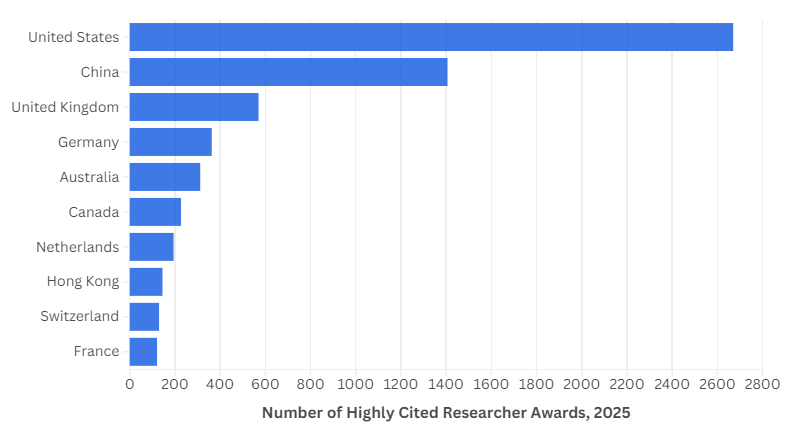
The analysis behind this year’s Highly Cited Researchers list, released today by indexing giant Clarivate, includes several tweaks aimed at reducing attempts to game the metric and excluding researchers who engage in questionable publication practices.
Those changes include removing highly cited papers from the calculations authored by researchers excluded from last year’s list for integrity issues. The company also applied specific removal criteria — including excessive self-citation rates, papers retracted for integrity concerns, and prolific publication rates — more comprehensively this year. In past years, the company had done so manually for particular geographic areas or disciplines.
“We’re trying to make sure that the indicators are valid and reliable, which means we have to include these kinds of filters or screens and quantitative tests that indicate some kind of quality, qualitative character,” David Pendlebury, head of research analysis at the Institute for Scientific Information at Clarivate, told Retraction Watch.
The changes have also made it possible for mathematics to return as a category in the 2025 list. Clarivate stopped including the discipline in 2023 after the field’s relatively small number of papers, as well as evidence of citation manipulation, led to the company to drop the discipline as a category.
“What we saw over time was the dominance of a particular topic taking over all of mathematics, and that had all the markings of people gaming as well,” Pendlebury said. “That is why we decided to suppress the field of mathematics for two years and find a solution which allowed the truly influential people to resurface, so that they could be selected and highlighted. And that’s fortunately what we have this year.”
Clarivate excludes retracted papers from its initial pool of data used to calculate the Highly Cited Researchers list. In 2022, the company started using the Retraction Watch Database for some of the qualitative components of its analysis, including checking the names on its preliminary list against the database for evidence of misconduct.
“The innovation of this year is that all these criteria are now more comprehensively and consistently applied across all researchers,” said Dmytro Filchenko, Clarivate’s senior director of research and analysis.
Those criteria include anomalous levels of self citation or group citation; authorship of papers retracted for integrity issues; community reports of breaches in research integrity; and prolific authorship, according to documentation for the Highly Cited Researchers list. The company also excludes authors with an anomalous ratio of reviews to articles.
The changes led to 2,400 researchers being excluded this year because of integrity concerns, 432 of which were for hyper-prolific authorship. The total number excluded has increased over the years, from 500 in 2022 to 1,000 in 2023 and over 2,000 last year.
“These improvements led to the fact that more space for new researchers whose work may have been overshadowed previously is now available,” Filchenko said. “Usually our retention rate — so, meaning the highly cited researchers from the previous year who appear again in the new year — is around 70 percent. This year, it’s 60 percent.”
This year’s list includes 7,131 Highly Cited Researcher designations to 6,868 people, with some being recognized in more than one field. The United States is home to the largest share of the researchers, 2,670 or 37 percent. That marks a 1 percentage point increase from 2024 and follows several years of declines.
China has the second highest number of researchers, with 1,406 or nearly 20 percent of the total highly cited list.
The list for mathematics includes 65 researchers. As part of reintroducing math to the list, Clarivate consulted with mathematician Domingo Docampo of the University of Vigo in Spain. Docampo and colleagues developed an algorithm independent of Clarivate’s methods to evaluate citations based on the quality of the citing reference. “We asked him to run his algorithm on the people who we nominated this year in mathematics,” Filchenko said. “Both algorithms were in agreement.”
As in years past, the list starts from the top 1 percent of papers in each field and publication year, and includes articles and reviews published in the last 11 years. In addition to removing retracted papers, Clarivate also excludes those with more than 30 authors or with group authorship. The company develops a preliminary list from the authors of those papers, applying the filters for research integrity concerns, publication practices, and so on, to arrive at the final list.
Just as authorship can be abused, so can citation practices.
“It’s amazing for me to see over the years, over these decades, how important these measures have become,” Pendlebury said. He reflected how Eugene Garfield, the founder of the Institute for Scientific Information, warned against overreliance on metrics. “He actually asked in one article, ‘Is the tail now wagging the dog?’ So he was always concerned and always cognizant of how these data can be misused.”
“We have had to deal with what is a rising tide of pollution in the literature, generally gaming of the publication citation metrics,” Pendlebury continued. “We have to deal and guard against gaming of these indicators, because we want them to be robust and reliable. That’s why we’ve had to include all these screens and filters.”
Like Retraction Watch? You can make a tax-deductible contribution to support our work, follow us on X or Bluesky, like us on Facebook, follow us on LinkedIn, add us to your RSS reader, or subscribe to our daily digest. If you find a retraction that’s not in our database, you can let us know here. For comments or feedback, email us at [email protected].
Mismatching data in the Clarivate HCR ranking in mathematics, confusion between authors with the same names, the ORCID ID and some missing primary affiliation.
1/ Checking the list for the category: “mathematics”, I found at list likely to be incoherent data for one researcher: affiliation, Orcid ID, and the Web of Science Researcher Profile for the concerned researcher.
2/ Fast checking
Incoherent data between Orcid ID: https://orcid.org/0000-0002-3345-3917
and data for the second paper of this ORCID page:
https://www.jstage.jst.go.jp/article/electrochemistry/advpub/0/advpub_25-00123/_article
These two sources of data do not correspond to the same researcher as can be checked with the open access list of the ten papers on the View Profile: https://www.webofscience.com/wos/author/record/F-7616-2014
It can be checked at the first article of this list:
https://www.webofscience.com/wos/woscc/full-record/WOS:001577712700001
More details on how to follow the successive redirections:
at page 6 of the HCR ranking in mathematics:
https://clarivate.com/highly-cited-researchers/?action=clv_hcr_members_filter&clv-paged=6&clv-category=Mathematics&clv-institution=&clv-region=&clv-name=&address1=
Extract :
Yamamoto, Masahiro Mathematics Romanian Academy, Romania View Profile
Clicking on the “View Profile” redirects to: https://www.webofscience.com/wos/author/record/F-7616-2014
Warning, it seems the orcid ID does not always appear at the above link.
The mentioned orcid ID in this profile is: https://orcid.org/0000-0002-3345-3917
However these data do not fit with the open access list of the ten papers on the View Profile: https://www.webofscience.com/wos/author/record/F-7616-2014
It can be checked at the first article of this list:
https://www.webofscience.com/wos/woscc/full-record/WOS:001577712700001
that the primary affiliation is:
Extract:
“Univ Tokyo, Dept Math Sci, Meguro,Komaba, Tokyo 1538914, Japan
Affiliation University of Tokyo”
I went shortly through the Clarivate HCR ranking in maths:
https://clarivate.com/highly-cited-researchers/?action=clv_hcr_members_filter&clv-paged=1&clv-category=Mathematics&clv-institution=&clv-region=&clv-name=&address1=
and found some incoherent data ate page 6: https://clarivate.com/highly-cited-researchers/?action=clv_hcr_members_filter&clv-paged=6&clv-category=Mathematics&clv-institution=&clv-region=&clv-name=&address1=
concerning the researcher Masahiro Yamamoto. It seems:
– A confusion was made between two distinct authors with the same name, visible on the successive Clarivate redirection pages:
– The Orcid ID corresponds to a first researcher 1 based in Konan University and does not seem to work in mathematics (I may be wrong) but on the page 6 of The HCR ranking in mathematics he appears as affiliated to the “Romanian Academy, Romania”
– The View Profile, except the Orcid ID, corresponds to another researcher 2 based at the University of Tokyo, his primary affiliation
However on the Clarivate HCR ranking in mathematics he is supposed to be affiliated to the: “Romanian Academy, Romania” and that his primary affiliation was and is not listed in the 2025 HCR ranking.
I found even more surprising data when I click on the hyperlink “View Profile” for him of the Clarivate HCR ranking at page 6: https://www.webofscience.com/wos/author/record/F-7616-2014
The “View Profile” page was showing the Orcid ID: https://orcid.org/0000-0002-3345-3917
which does not correspond to the researcher Masahiro Yamamoto working in mathematics and the list of ten papers appearing on the View Profile Clarivate Webpage for this author.
It seems the Clarivate HCR ranking in mathematics still needs some clarifications, as well as the Orcid ID when several researchers have the same name and first name.
Fatiha Alabau-Boussouira
I contacted the ISI Team. It seems some of the inconsistencies have now been corrected:
the Orcid ID in the View Profile available at the View Profile url: https://www.webofscience.com/wos/author/record/MTA-8195-2025
is now: https://orcid.org/0000-0002-4050-871X
and no longer: https://orcid.org/0000-0002-3345-3917
Today, 21 november 2025, not any citation data is yet available at the View Profile page: https://www.webofscience.com/wos/author/record/MTA-8195-2025
This might be corrected in a near future. I did not yet receive answers from the ISI Team.
Some news and some new data related to citation indexes for mathematics:
I received some thanks several weeks ago from the ISI Team. On January 4th 2026, not any citation data is yet available at the View Profile page: https://www.webofscience.com/wos/author/record/MTA-8195-2025.
However, I want here to comment on another issue concerning citation data in mathematics, including Web of Science citations. I noted the Elsevier article: 10.1016/j.cam.2014.01.002
[1] R. Khalil, M. Al Horani, A. Yousef, M. Sababheh, A new definition of fractional derivative, Journal of Computational and Applied Mathematics,
Volume 264, 2014, Pages 65-70,
https://doi.org/10.1016/j.cam.2014.01.002.
for its high indexes of citations in Web of Science, zbMATH, MathSciNet and Google Scholar.
I give detailed mathematical comments of this highly cited article in the preprint available at the link: https://hal.science/hal-05412136
In Section 13, we raise major concerns about scientific publishing, peer-review and editorial processes, and citations handling in these evaluations processes, since an article such as [1] largely paraphrasing basic definitions and results in classical differential calculus could be published and is still largely cited.
I also give extracts of some of the citation data between 6 November 2025 and 11 December 2025.
The Web of Science citations for [1] between 6 November 2025 and 4 January 2026 are:
6 November 2025: 2681
11 December 2025: 2806
4 January 2026: 2831
This raises concerns about the use of citation indexes to replace the reading of published peer-reviewed articles, especially when peer-review and editorial handling failed to detect major issues in a submitted manuscript, but also on the handling of the presentation of the literature, the list of references and the citation practices in most of the citing articles of [1].
How such paraphrasing of a basic mathematical notion, the notion of derivative of a real-valued function of the real variable, could be highly cited in mathematical journals and articles indexed in Web of Science?