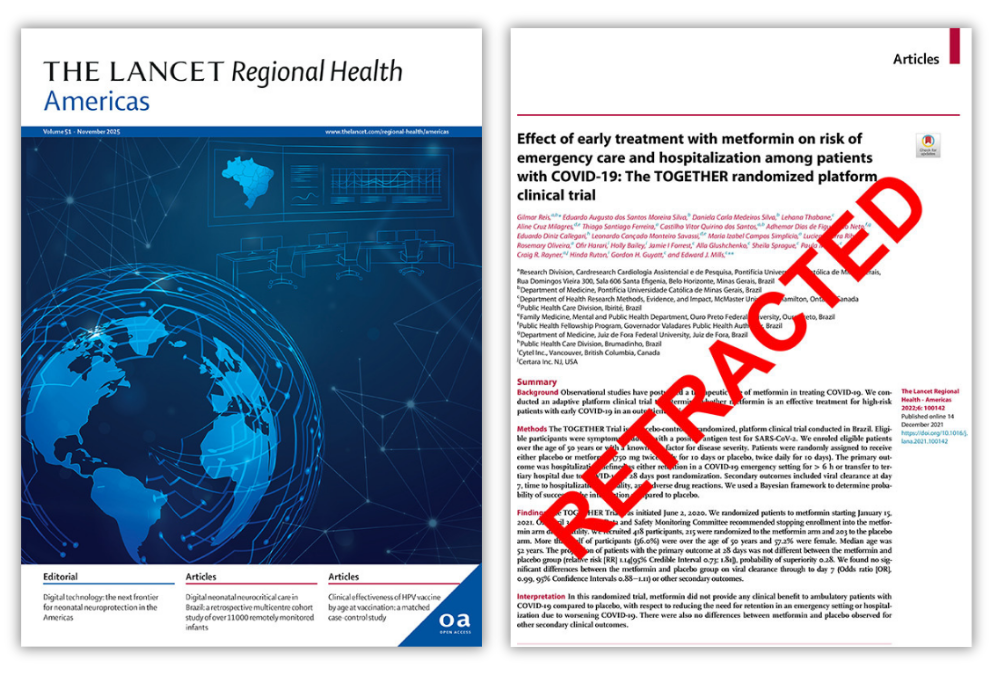
Lancet journal retracts COVID-19 metformin paper nearly 2 years after authors request correction

A paper on a clinical trial of metformin for the treatment of COVID-19 has been retracted nearly two years after the authors flagged data issues that resulted in an expression of concern. 

The results of the Brazil-based TOGETHER trial, published in December 2021 in The Lancet Regional Health–Americas, found metformin was no better than placebo at improving health outcomes in people with COVID-19. The study has been cited 45 times, 25 of which came after the expression of concern was published, according to Clarivate’s Web of Science. 

Early observational studies in people with COVID-19 found positive effects of metformin, an oral medication most often used for type 2 diabetes, including reduced disease severity and mortality rates. But clinical trials, including the now-retracted study and a more recent randomized trial, found no differences in time to recovery or disease severity between patients who got metformin and those who received placebo. 

Continue reading Lancet journal retracts COVID-19 metformin paper nearly 2 years after authors request correction
Why has it taken more than a year to correct a COVID-19 paper?

A correction to a clinical trial on a potential treatment for COVID-19 has taken more than a year — and counting — to get published. In the meantime, the article remains marked with an expression of concern that appeared in February 2024. 

The Lancet Regional Health–Americas published the study, a randomized clinical trial of the effect of metformin on hospitalization rates among COVID-19 patients, in December 2021. It has been cited 36 times, according to Clarivate’s Web of Science, 12 of those since the publication of the expression of concern.

In December 2023, the authors “identified small errors in the statistical analysis primary outcome,” corresponding author Edward Mills, a health research methods professor at McMaster University, in Hamilton, Ontario, told Retraction Watch. “We immediately re-ran the analysis and submitted as an erratum,” he said. 

Continue reading Why has it taken more than a year to correct a COVID-19 paper?