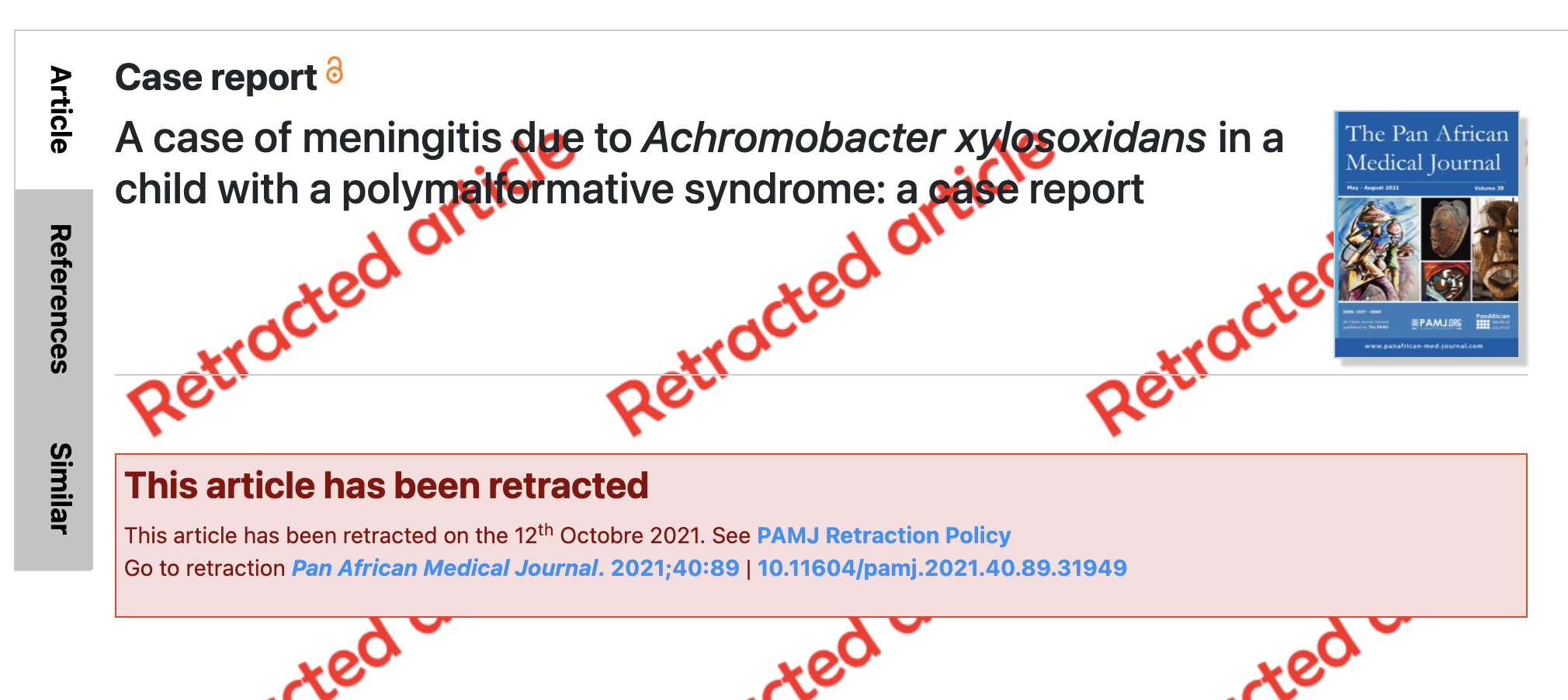
A group of neurosurgery researchers in Tunisia have lost a 2021 case study on childhood meningitis after the editors discovered evidence of plagiarism and image manipulation.
The article, “A case of meningitis due to Achromobacter xylosoxidans in a child with a polymalformative syndrome: a case report,” appeared in the Pan African Medical Journal and was written by a team lead by Mehdi Borni, of the Department of Neurosurgery at University Hospital Center Habib Bourguiba, in Sfax.
A Wisconsin physician who has been pushing unproven treatments for Covid-19 has lost a paper on a hospital protocol his group says radically reduced deaths from the infection after one of the facilities cited in the study said the data were incorrect.
Pierre Kory, whose titles have included medical director of the Trauma and Life Support Center Critical Care Service and chief associate professor of medicine at the University of Wisconsin School of Medicine and Public Health, in Madison, has become a key figure in the controversy over the use of ivermectin — the deworming agent that proponents insist can treat Covid-19 despite a lack of evidence that it does.
In late December 2020, Kory — who rails on Twitter about unfair and incompetent journals — and another ivermectin advocate, Paul Marik, of Eastern Virginia Medical School in Norfolk, and several other authors published a paper in the Journal of Intensive Care Medicine on a group they’d created called the Front-Line COVID-19 Critical Care Alliance. Per the article:
The Anatomical Record is correcting itself in a big way, pulling 13 articles, including several linked to paper mills.
The papers, all by authors in China, were published between 2019 and 2021.
Some were flagged in a September 2021 report on research misconduct by the Chinese government. They join a slew of articles The Anatomical Record has retracted since 2020 for similar concerns.
Springer Nature has retracted 44 papers from a journal in the Middle East after determining that they were rubbish.
The articles, which showed up in the Arabian Journal of Geosciences starting earlier this year, many of which involve at least some researchers based in China, and from their titles appear to be utter gibberish — yet managed still to pass through Springer Nature’s production system without notice.
A prominent astronomer at the University of Texas in Austin has withdrawn a preprint and a published paper after critics accused him of perpetuating inequality in the field, saying he is more sorry “than words can say” about the matter and that he is taking a hiatus from his work to allow the controversy to subside. He is also putting publication of a book he wrote on the subject on hold.
Kormendy published the work last week as a preprint on arXiv before it appeared in PNAS but after he’d received word from the journal that it had been accepted.
The authors of a study purportedly showing that ivermectin could treat patients with SARS-CoV-2 have retracted their paper after acknowledging that their data were garbled.
A journal devoted to LGBT issues has retracted a paper on the “process by which transgender youth come of age” because “the reported outcomes can no longer be considered valid.”
The article, “Becoming trans adults: Trans youth, parents, and the transition to adulthood, Journal of LGBT Youth,” was written by Jonathan Jimenez, at the time a graduate student in sociology at the University of Nevada, Las Vegas (UNLV).
The paper, which appeared in the Journal of LGBT Youth, was his first solo article, Jimenez tweeted when the publication came online in August 2020, saying he was “unbelievably happy” to share the news.
A pediatrics journal has issued an expression of concern for a 2007 paper by a group of Canadian researchers whose leader, Gideon Koren, resigned in 2015 under a cloud after concerns surfaced about the integrity of the data in hundreds of his published studies.
Koren, once a prominent pediatrician and pharmacologist at the University of Toronto’s Hospital for Sick Children, ran the institution’s Motherisk Drug Testing Laboratory, which conducted hair testing for perinatal exposure to drugs and alcohol. In 2015, an investigation prompted by The Toronto Star found serious problems with the tests, which had been used in “used in thousands of child protection cases and several criminal cases.”
Koren stepped down that year, and in 2019 relinquished his license to practice medicine in Ontario. Reporting by the Star prompted Koren’s institution to order a review of more than 400 of his published papers. To date, by our count, journals have retracted five of Koren’s papers, corrected four, and have now issued three expressions of concern.
According to the society, Saitoh had committed ethics violations in 10 articles, three of which had already been retracted and seven of which remained in the wild. (Saitoh had been a frequent co-author with Yoshitaka Fujii, currently our record holder for most retractions by a single researcher — 183 — but the JSA report found that he’d committed misconduct on his own, too. He has 53 retractions, according to our count, placing him seventh on our leaderboard.)
Four of those 10 articles appeared in the Canadian Journal of Anesthesia and two others were published in the British Journal of Anaesthesia. (The seventh paper, in the Fukushima Journal of Medical Sciences, has since been retracted.)
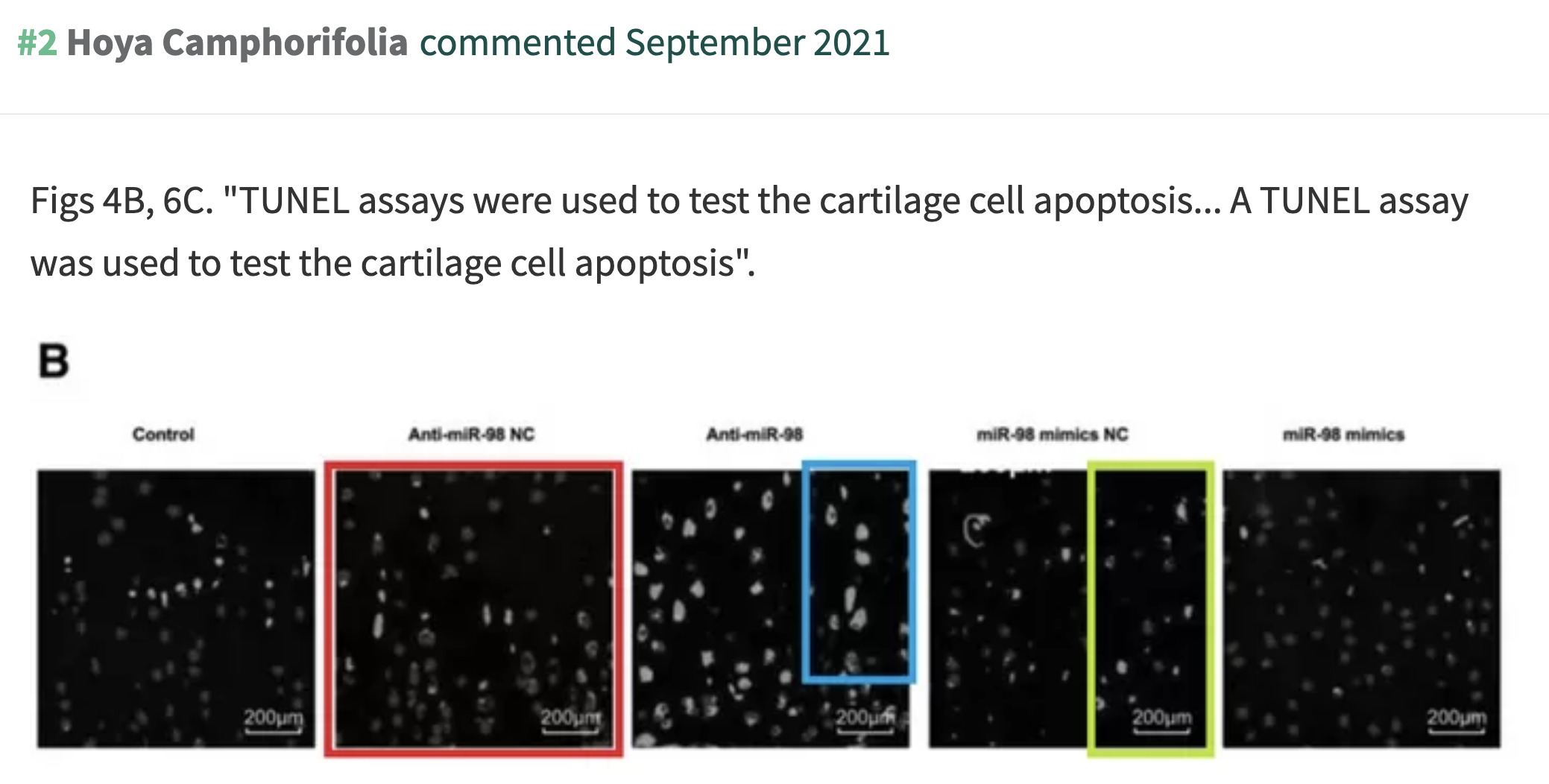
In 2016 Genetic Testing and Molecular Biomarkers published a paper on osteoarthritis by a group at Linyi People’s Hospital in China. Five years later, the authors contacted the journal asking for the correction of a pair of figures — but, as the publisher, Mary Ann Liebert, explained, the new files were “not workable.”
In May 2021, the journal issued an expression of concern for the paper (which, we’ll note, unfortunately sits behind a paywall). And earlier this month, it was retracted. For the rest of the story, read the retraction notice (caution, the following text might contain trigger words for unethical researchers):