
Within hours of researchers from prestigious institutions discovering they were listed as authors on a fabricated paper, the website for the journal and publisher has been taken down.
Cardiologist Eric Topol, the executive vice president of Scripps Research, posted on X yesterday that his name appeared on a “fraudulent” paper published in the so-called Journal of Digital Health Implementation. He suspected the article, dated March 29 and titled “Implementation Science for AI Integration in Digital Health Systems,” was AI-generated.
“If there ever was an AI-generated paper, this one would qualify as a high probability of being so,” Topol, who is also founder and director of the Scripps Research Translational Institute, told Retraction Watch.
Michael Matheny, a professor at Vanderbilt University Medical Center, told us he discovered he was listed as an author on the paper after a colleague asked him about it. He then alerted the others listed, noting there were “small errors in the naming and affiliation.” For example, Matheny’s middle initial was incorrect, and several of the authors’ first initials were also wrong.
Of the six authors listed, five told us they had never seen the paper before. We couldn’t find a researcher matching the sixth name and affiliation, A. B. Martin with the Imperial College of London.
Adding the authors’ names on the fraudulent paper was “grossly illegal,” Topol said.
Identity theft in academia is something we see often. Researchers may impersonate reviewers or former colleagues, or be the target of hijacked journals. Some journals and organizations have proposed conducting identity checks.
Another listed author, Effy Vayena of Swiss Federal Institute of Technology in Zurich, told us the paper “clearly used names of well-known academics which increases the likelihood that the wider community might want to read it or potentially cite it.” Topol is one of the top 10 most cited researchers in medicine.
Topol posted about the paper on X in the early afternoon, and by the evening the website no longer loaded. Archived versions of the top-level domain, e-pubmed.co.uk, show the URL was formerly affiliated with another publication in Russian.
Before it was removed, the homepage for the “publisher” of the journal, Ellinger Publishing Media, bore a resemblance to that of Springer Nature Link, a portal to search all publications by the brand. The publisher listed four journals, including the Journal of Digital Health Implementation. The edition containing the fraudulent article was the first volume for the journal or the publisher.
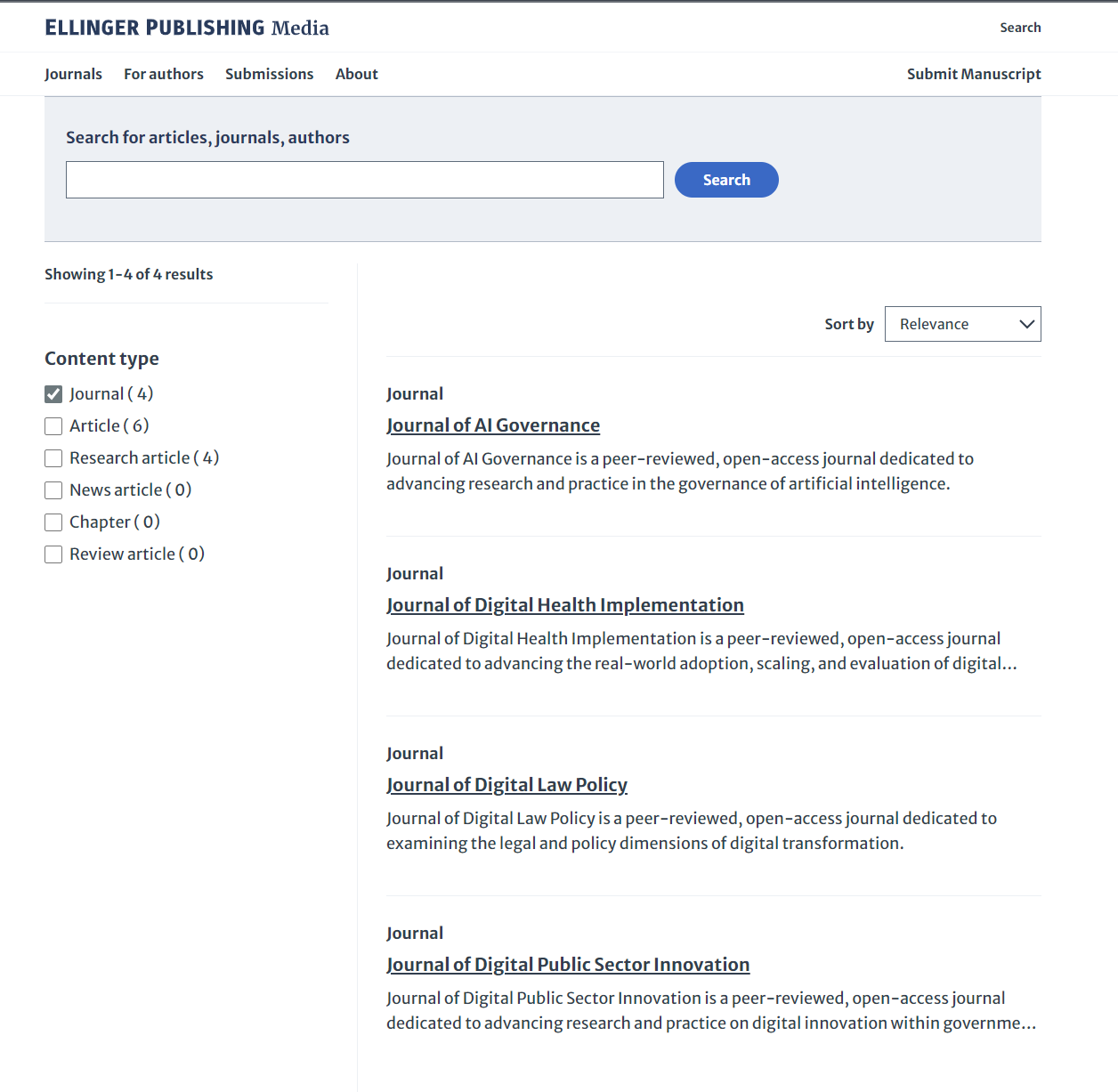

Ellinger Publishing claimed to be a U.K. publishing company but does not appear in the U.K. business registry. The listed address is a coworking space in London.
The DOI for the paper links to Zenodo, an open repository. The Zenodo page associated with the paper was removed for copyright infringement.
“What scares me is that we’ve reached a point where it’s difficult to protect our academic work and identity,” Vayena said. “This is incredibly dangerous not only for individual reputations and trust in academic work but also for the actual scientific knowledge.”
Like Retraction Watch? You can make a tax-deductible contribution to support our work, follow us on X or Bluesky, like us on Facebook, follow us on LinkedIn, add us to your RSS reader, or subscribe to our daily digest. If you find a retraction that’s not in our database, you can let us know here. For comments or feedback, email us at [email protected].
The Open Science Foundation has developed opensci.id (https://opensci.id/) which verifies the ORCID against government IDs to combat exactly this problem. The leading digital health publisher JMIR Publications is actually about to pilot this for their reviewers and selected guest editors and authors. More publishers are expected to come on board. Science needs more accountability, and hopefully more authors will submit with their verified ORCID to combat this problem. Know your contributor!