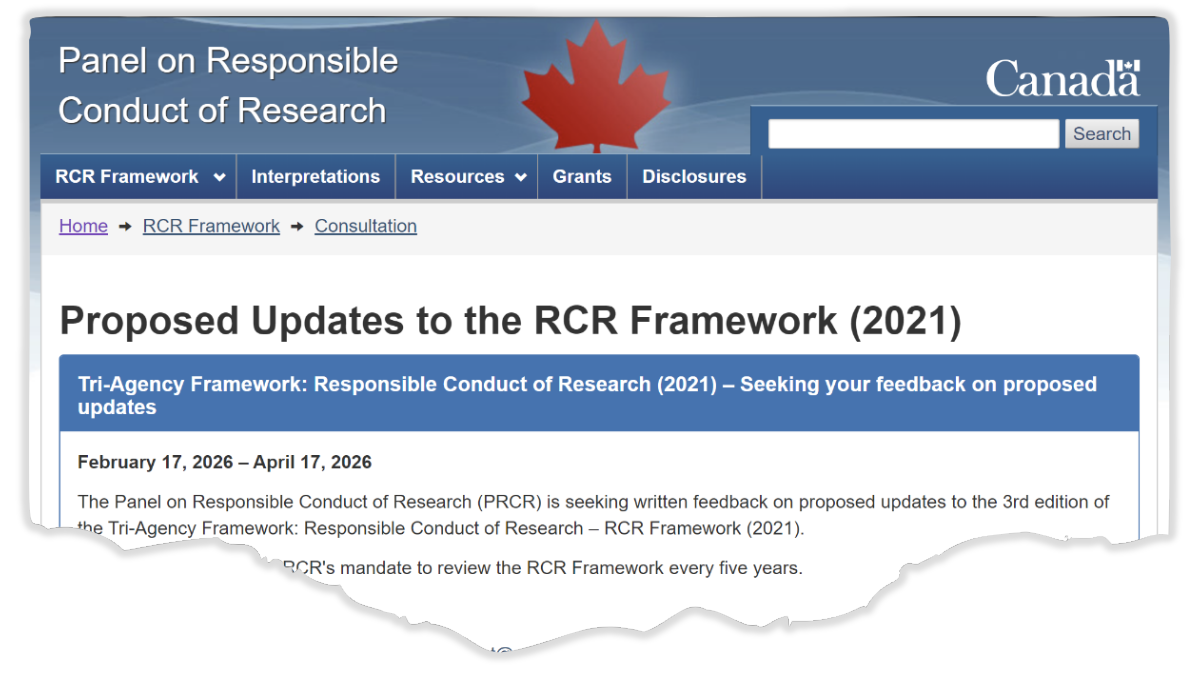
A Canadian panel is proposing several changes to its guidelines for responsible conduct of research, including a provision that effectively removes any statute of limitations on investigations into potential misconduct.
The proposed revisions, from the Canadian Panel on Responsible Conduct of Research (PRCR), are up for public comment until April 17 and have not been made official. The PRCR is an interdisciplinary review and advisory body to Canada’s three federal research funding agencies: the Canadian Institutes of Health Research, the Natural Sciences and Engineering Research Council, and the Social Sciences and Humanities Research Council.
The policy under consideration applies to researchers receiving Canadian federal research funding as well as the institutions administering those funds. Nearly a decade after the framework was first published in 2011, the highly publicized case of Jonathan Pruitt, a federally funded behavioral ecologist, came to light. Pruitt was found to have fabricated and falsified data, and the case has been cited as an example of systemic weaknesses in research oversight in Canada.
Among the highlights of the proposed changes is a change in the definition of an “allegation,” clarifying that an allegation constitutes an assertion of wrongdoing made “at any time.” According to the PRCR panelists, “the addition of ‘at any time’ reiterates that there is no statute of limitation to submit an allegation.”
That language represents a critical difference from federal regulation in the United States, which generally has a six-year statute of limitations – with exceptions for continuing issues – for pursuing research misconduct, according to Minal Caron, an attorney at Ropes & Gray LLP in Boston.
“The existing policy is silent on a statute of limitations,” Caron said. “Now there’s an affirmative statement that institutions cannot decline to review an allegation solely because too much time has passed since the work was published or submitted. This language would be really significant” if it stays in the document “because it would appear to compel institutions to review allegations even if, for example, they involve papers published decades ago and none of the authors can even be located by the institution to explain what might have happened.”
Other key proposed changes include:
- Institutions could consider both anonymous allegations and also “an allegation in the public domain” if accompanied by sufficient information to allow for investigation.
- Institutions would be obligated “to hold respondents accountable, even when they are no longer affiliated with the institution.” Those responsibilities may include “requesting that journals correct the research record.”
- Institutions would need to formally recognize a newly articulated type of conduct breach, namely “making false allegations with malicious or vexatious intent” or in retaliation “against a complainant who has made allegations in good faith.”
The proposed update also adds new policy requirements regarding open science and research data management, with researchers required to comply with the tri-agency’s Open Access Policy on Publications.
Karen Wallace, director general for the Secretariat on RCR, said the proposed changes are part of routine updates of the framework completed every five years.
“The research landscape continues to evolve, and so must the RCR framework,” said Wallace, noting the need to consider emerging issues like AI and research security. “The document needs to keep pace with the current state and evolution of science, and we want it to continue to support rigorous, ethical and high quality research,” she said.
In a follow-up with us, she said the panel has “found that complainants often have valid reasons for delaying the submission of an allegation,” including fear of retaliation. “Removing statutes of limitation would ensure these allegations are still accepted and addressed when individuals are ready to come forward.”
“Institutions are the ones responsible for addressing allegations of breaches,” said Wallace, who also stressed that Canadian RCR policy uses the term “breaches” instead of “misconduct.”
Canadian institutions investigating their own conduct breaches, and a lack of transparency in these investigations, have been the subject of criticism in the past. (Earlier this year, our co-founder, Ivan Oransky, testified on the inherent conflict of interest of institutional self-policing at a hearing of the Standing Committee on Science and Research in Canada’s House of Commons.)
The proposed update also clarifies institutional processes, Wallace said. For example, if an investigation into an alleged breach pertains to research involving “distinct groups,” including First Nations, Inuit or Métis peoples, “we would want to ensure that there is representation from that community on the Investigation Committee,” Wallace said.
The previous version of the policy did not include language around Indigenous people involved in research, so new, more specific language makes the proposed update more inclusive, said Gengyan Tang, a Ph.D. candidate at the University of Calgary studying research integrity policy.
As for gaps in the proposed policy update, Tang, who was not part of the panel, expressed concern about vagueness around institutional RCR education, including responsibility for promoting education and awareness of RCR.
“I think it’s too ambiguous in that section,” he said. He noted some universities hold an “Academic Integrity Week,” but the policy offers no details on how institutions are to deliver and implement academic integrity education.
A remaining difference between Canadian and U.S. policy, at least in practice, lies in the provision in the PRCR framework that states: “In determining whether an individual has breached an Agency policy, it is not relevant to consider whether a breach was intentional or a result of honest error. However, intent is a consideration in deciding on the severity of the recourse that may be imposed.”
In the United States, Caron explained, investigation committees are often sympathetic to honest error and start with the presumption of innocence. “After all, respondents are entitled to a presumption of innocence and mistakes can be made by any researcher, no matter how diligent,” he said. But findings of honest error can sometimes be problematic, because in many cases respondents cannot back up that claim with verifiable source data.
“Sometimes, when you unpeel the onion, the ‘honest error’ explanation doesn’t hold,” he said. “I believe this tension is why the HHS Office of Research Integrity emphasized in its honest error guidance last year that committees should review source data really carefully before making any honest error finding.”
With reporting by Adam Marcus and Lesley Evans Ogden.
This article was amended on April 11, 2026, to correct the date the framework was first published (2011) and to clarify what would change with the proposed revisions. We also added a follow-up comment from Wallace on the statute of limitations issue.
Like Retraction Watch? You can make a tax-deductible contribution to support our work, follow us on X or Bluesky, like us on Facebook, follow us on LinkedIn, add us to your RSS reader, or subscribe to our daily digest. If you find a retraction that’s not in our database, you can let us know here. For comments or feedback, email us at [email protected].