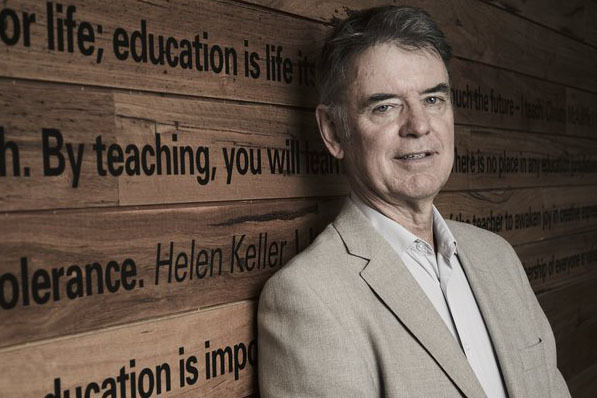
The University of Melbourne has opened a formal investigation into the prominent Australia-based education researcher John Hattie, backtracking on a decision months ago that concerns about his work didn’t warrant further scrutiny.
The investigation, confirmed in a letter seen by Retraction Watch, was triggered by allegations made by Stephen Vainker, a teacher and former doctoral researcher in the United Kingdom, who documented what he says are hundreds of instances of plagiarism and data errors across Hattie’s body of work. The investigation also follows our coverage last August.
Vainker also discovered what seems to be a hallucinated reference in one of Hattie’s recent writings, prompting a book publisher to remove it from the work.
Hattie has previously denied the claims of plagiarism and has called Vainker’s allegations against him “cyber-bullying and trolling.” When we asked him about the investigation, he said he agrees with the university’s decision as “it is the policy of the university to so investigate.”
As we reported last year, after Vainker had flagged more than 180 alleged instances of plagiarism across Hattie’s work, the university’s pro vice-chancellor for research capability, Kate Smith-Miles, said in June a formal investigation into Hattie’s work was “not necessary or appropriate.”
At the time, the university had reviewed 14 of 181 of Vainker’s allegations at random, finding none amounted to misconduct. But the school acknowledged “a number of unintended errors” and “improvements” that could be made to Hattie’s citation practice, according to a letter summarizing the findings of its preliminary assessment.
Vainker pushed back, singling out 11 instances he argued showed word-for-word copying. A research integrity officer at the university said these examples “have given rise to concerns which were not apparent from our initial random sample review,” and said the university was seeking additional information from Hattie, whose response would determine whether further action was warranted.
Following that exchange and our reporting on the case, Smith-Miles informed Vainker in a letter dated September 8 that the university decided to open an investigation into whether Hattie had breached the Australian Code for the Responsible Conduct of Research. An investigation panel will make findings of fact and recommend any remedial or corrective steps, according to Smith-Miles’ letter.
Last year, Hattie filed a defamation lawsuit against Vainker in the Supreme Court of Victoria, in Australia. Hattie’s lawyers have also previously demanded that Vainker apologize, retract his online comments and withdraw his complaint to the university. Vainker said hasn’t heard anything further about the legal action, but Hattie told us the “matter is still under consideration.”
A spokesperson for the university did not provide further details about the investigation, saying their process “prioritises procedural fairness, confidentiality and integrity,” and that “maintaining confidentiality is essential to ensure any investigation process is conducted fairly. This includes protecting the rights of those raising concerns and those subject to review.”
Separate from the formal investigation, Vainker identified what seemed to be a nonexistent reference in a foreword Hattie wrote for a recent book, Research Handbook on Innovations in Assessment and Feedback in Higher Education. A press officer at Frontiers in Psychology, the journal cited in the reference, confirmed the article does not exist.
Vainker alleges the reference was AI-generated. He notified the university, which in turn referred the matter to the publisher, Elgar Publishing.
“Yes [Vainker] detected an error, and the publisher agreed to remove it immediately,” Hattie said of the reference, adding that correcting errors in print-on-demand publishing is common and “no indication of intentional wrongdoing.”
“I thank Vainker for the error detection,” he continued. “I would hope, as publishers, they would allow authors the opportunity to make corrections when errors are spotted – there is no sleuth, no sneakiness – just good editorial practice.”
Hattie denies using AI to write the foreword. “So how did it happen – I really know not. Yes, I use Grammarly but I am reluctant to use AI given the usual reasons and Vainker’s pursuit.”
The publisher has since removed the reference from the foreword that appears on their website, although it still appears in the version on Google Books.
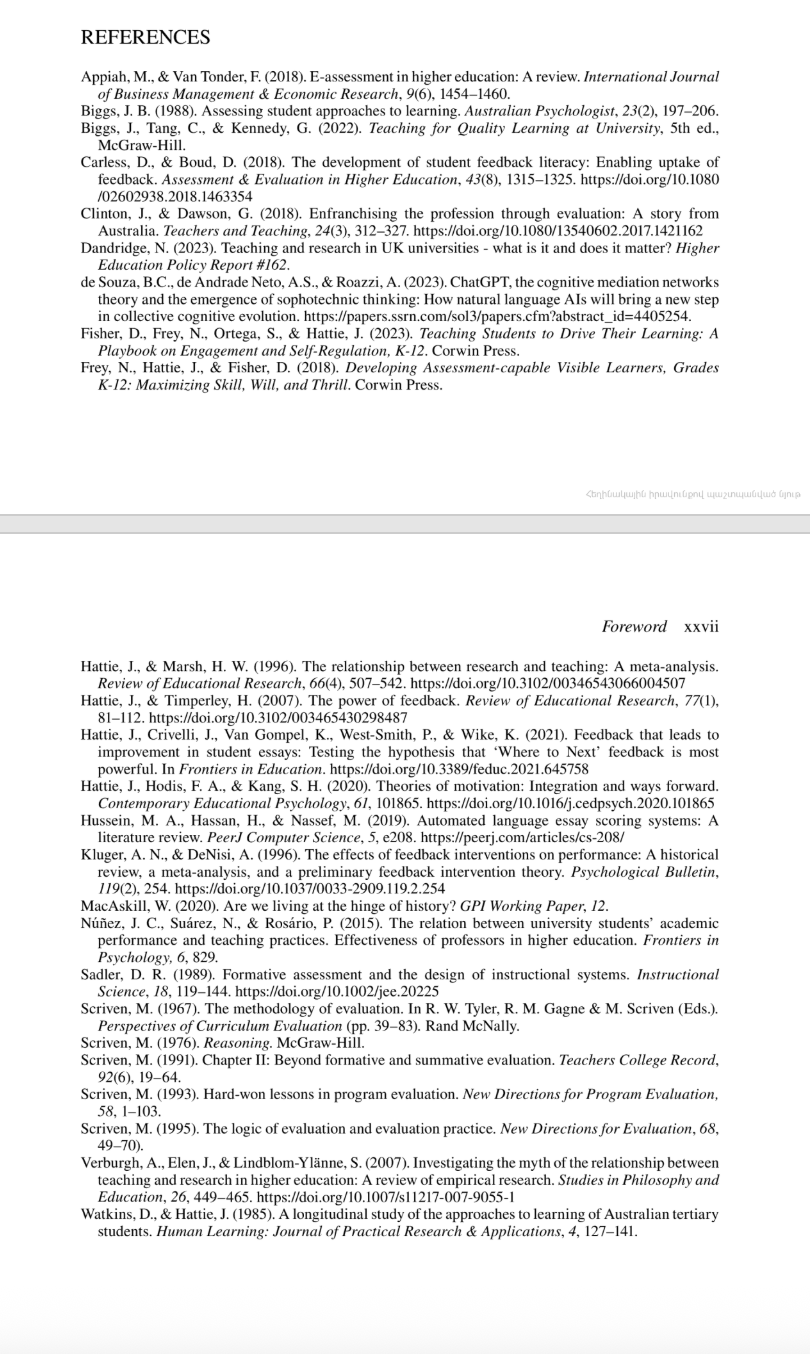
Alex Pettifer, the editorial director at Elgar, confirmed the edit was made last month “after consulting with Professor Hattie who confirmed that an erroneous reference had appeared in their Foreward [sic] and was caused by the them [sic] not properly checking back against a source list of references after writing different drafts.”
“The two Editors of the Handbook were also consulted and both backed the quality of the Foreward and were in agreement that this edit should take place without the need for an errata slip or retraction notice being issued,” Pettifer added.
Like Retraction Watch? You can make a tax-deductible contribution to support our work, follow us on X or Bluesky, like us on Facebook, follow us on LinkedIn, add us to your RSS reader, or subscribe to our daily digest. If you find a retraction that’s not in our database, you can let us know here. For comments or feedback, email us at [email protected].
Including a reference that does not exist tells you that the author cited an article that he didn’t read…and could not have read. What does that say about his level of academic scholarship?
Not surprised this kind of thing happens in Unimelb again
Having worked for decades as a referencing advisor and editor in several research organisations, I would be more surprised to find error-free referencing in any works. Academics often make errors even when referencing their own work. This is because accurate referencing relies on accurate data, which is not a given. Close attention to a myriad of technical details is vital while referencing software and others’ personal opinions on what ‘correct’ is for any given style adds further complexity.
The problem is not simple errors, the problem is hallucinated references – completely and irredeemably nonexistent.
Getting pagination wrong, or misspelling a title is one thing. “Citing” an article whose title does not exist with a page range that spans two articles, neither having anything to do with the citation, maybe with authors who never published together, that’s not a minor error.
Wait, a ~10% sample of reported problems, and then dismissal of the rest without checking?
Hire some people who will do the whole job please.
If they did a proper power analysis, which I assume they didn’t, and if the sample was truly random, which we would have to trust it was, checking a sample is nothing to object to. It’s a standard approach in quality control after all because you need to balance with costs.
“Balancing with costs” is a politician’s excuse to execute a cover-up, which is exactly what happened here.
When referencing is systematically incorrect it tells you something about the reliability or trustworthiness of the ‘scholarly work’. We need rigour and those with the courage to point out academic misconduct need to be celebrated and supported. It also raises questions about the quality of publishers, journal editors etc… So often poor academic governance is the systemic cause of individual failure. The devil is in the details, so I hope attention is given to proper scrutiny of all the work that has been flagged.
I am surprised that an editor didn’t pick up a non-existent reference. When I used to edit course materials at a university, we checked every reference and occasionally found mistakes such as incorrect details or two items having been inadvertently swapped. Never had one that didn’t exist though.
They are acquisitions editors, not line editors or copy editors. They do not edit.
The journals have no line editors and many have no copy editors. Various disasters occur fairly regularly and it is up to the author to find them in the proofs.
I have seen an entire book more or less shredded by a misuse of the formatting
software – something I was able to catch and point out to the editor. Normally these editors do not see the articles post-acceptance, and in general there is no reason for them to do so.
Even in the more serious forms of publishing (such as commercial fiction) the various kinds of editors coexist. Not all editors are expected to edit.
Within the specific discipline of copy editing there is, again, a wide range, and in some sectors it does include a substantial element of fact checking, where there is a perceived need for it. This does not apply in the context of academic journals.