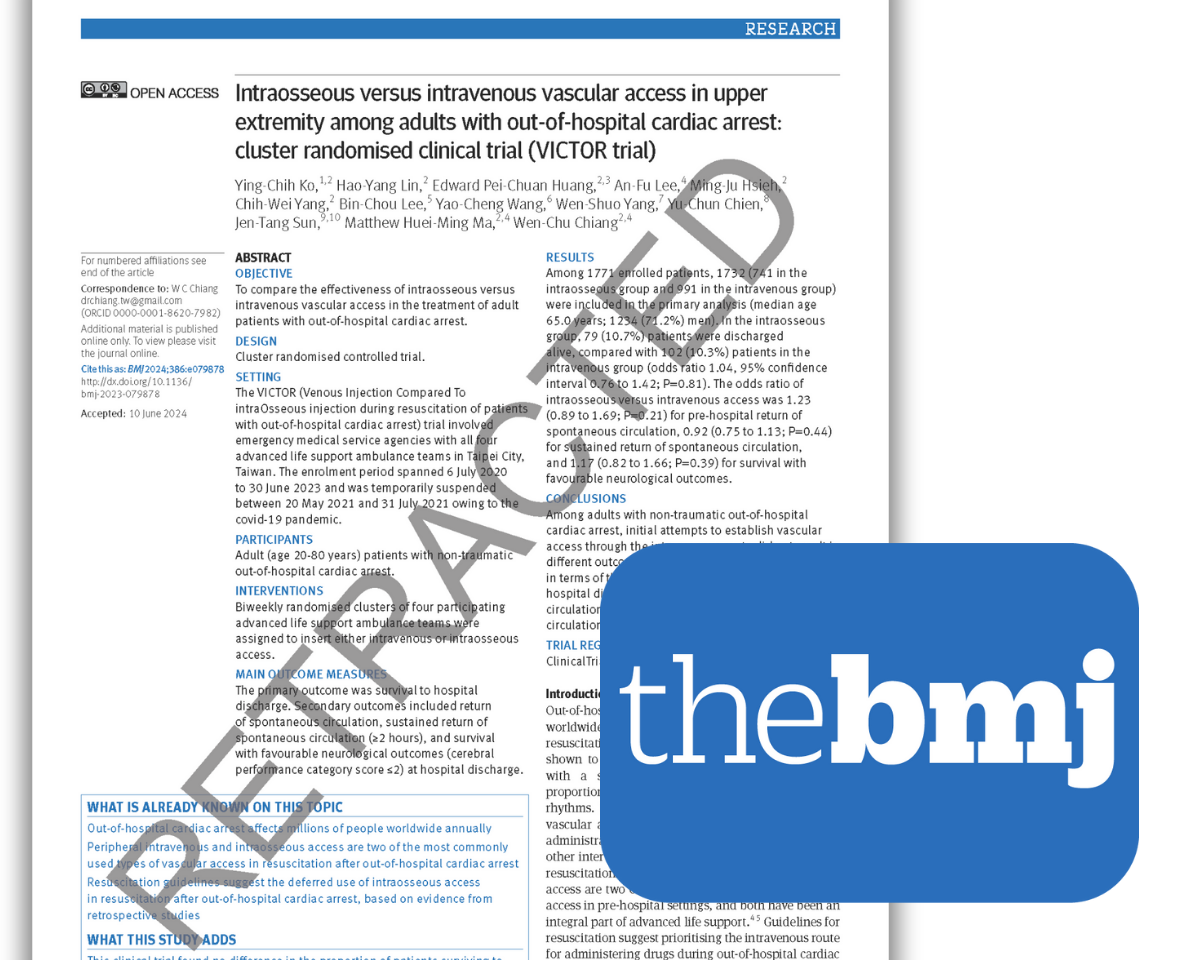
The BMJ has retracted a paper on a clinical trial of different methods of vascular access during cardiac arrest after an expert raised concerns about the randomization in the trial.
The study, published in July 2024, reports the results of a trial comparing intravenous and intraosseous vascular access for treating people who experienced cardiac arrest. It has been cited 29 times, according to Clarivate’s Web of Science.
The retraction marks the 13th The BMJ has issued since its first in 1989, according to the Retraction Watch Database.
The December 18 retraction notice references an online comment that “raised concerns about the randomisation scheme and allocation ratio” in the study. Although it doesn’t directly identify the comment, a rapid response to the paper on Sept. 9, 2024, by Lars Andersen, a professor of clinical medicine at Aarhus University in Denmark, mentions the same concerns covered in the notice.
Andersen told us retracting the article was the correct decision, and that “issues with the trial and the manuscript were quite severe” and “could lead to bias and incorrect conclusions.”
In his comment on the article, Andersen, who is also a statistical reviewer for the Journal for the American Medical Association, noted the randomization of the interventions and the ratio of patients in each treatment group did not occur in the same ratio the authors had specified.
The emergency response teams were randomly assigned to use either intravenous or intraosseous access for cardiac patients for a two-week period. The trial stated this would be a 1:2 ratio, with twice as many people in the intravenous group as the other. In reality, the data showed periods with no randomization, where all teams were assigned the same mode of treatment, and periods with an equal ratio of treatments.
Study coauthors Ying-Chih Ko and Wen-Chu Chiang, both researchers at the National Taiwan University Hospital, responded to Andersen’s comment, acknowledging the “potential explanations for this phenomenon mentioned in the manuscript are not strongly convincing.” They said they were attempting to achieve an “approximate” 1:2 ratio.
Andersen shared a more lengthy explanation of his concerns with the journal on Oct. 17, 2024, which expanded on the discrepancies. “The correct description of the randomization should be provided in the manuscript,” he wrote.
Another discrepancy Andersen pointed out in his comment was the number of patients that ended up in each treatment group, which was roughly the same for intraosseous and intravenous delivery — around 3,900 people — rather than the 1:2 allocation ratio the authors set out to include. In the paper, the authors speculate the unexpected similarity may have been caused by the COVID-19 pandemic or “of prolonged pre-hospital time” in the intravenous group, “potentially leading to lower turnover and fewer overall emergency medical service dispatches.”
Chiang told us the journal’s editorial office “confirmed that this retraction in no way implies any ethical lapses or misconduct.” He also called the errors “unintentional procedural errors arising from manual randomisation interpretation, most of which occurred during the COVID-19 pandemic in Taiwan.”
The authors “launched an exhaustive one-month re-examination” of the data, Chiang said, and confirmed some of the data “did not strictly adhere to the schedule due to unprecedented disruptions to our research operations during the pandemic.”
The authors requested a retraction and replacement or a correction of the article, but “fully respect” the decision to retract, Chiang said.
Last month, The BMJ issued an expression of concern for a stem cell paper criticized for a “complete mismatch” between the data and the study itself. Last November, the journal retracted and replaced an article on unexpected weight loss as a sign of cancer.
Like Retraction Watch? You can make a tax-deductible contribution to support our work, follow us on X or Bluesky, like us on Facebook, follow us on LinkedIn, add us to your RSS reader, or subscribe to our daily digest. If you find a retraction that’s not in our database, you can let us know here. For comments or feedback, email us at [email protected].
In the paper they try to gloss over the discrepancy between the group sizes and what was expected under randomisation, but it is a difference that is extremely unlikely to occur by chance. That leads to a couple of questions. The first is why? Did the emergency response teams just choose what they were going to do to the patients? Does that introduce a bias? The second is whether the treatment given to each patient was correctly recorded? If not, then it is beyond help. It is unlikely that the study is salvageable. They should have definitely sorted this out before publication. Strange results in randomised trials are almost always the result of error.
The specific structure of the data doesn’t support free choice of method by the individual response teams. There is a very clear block structure where during some weeks all teams used the same method, whereas during others, some teams appear to have been assigned to each method.
Given this block structure it is quite surprising to find equal numbers in the two conditions, as substantially more team-weeks were assigned to one condition than the other. I can’t think of an explanation for this that does not invalidate the study. Some possibilities are that the decision to report on a case was not independent of the treatment condition; that the randomization did not happen as planned; that either teams or weeks were not interchangeable; or that something bad has happened to the data.