PLOS One has retracted two papers from the Comet Research Group, a controversial cadre of researchers who, according to their webpage, seek “to find evidence about comet impacts and raise awareness about them before your city is next.”
The same research group was also behind a September 2021 paper — published in Scientific Reports and covered by Retraction Watch here, here, and here — that claimed a cosmic airburst flattened the city of Tall el-Hammam 3,600 years ago, providing physical support for the biblical story of Sodom and Gomorrah. The widely publicized paper was retracted last April after mounting concerns from outside researchers about the methodology, interpretations and data in the article.
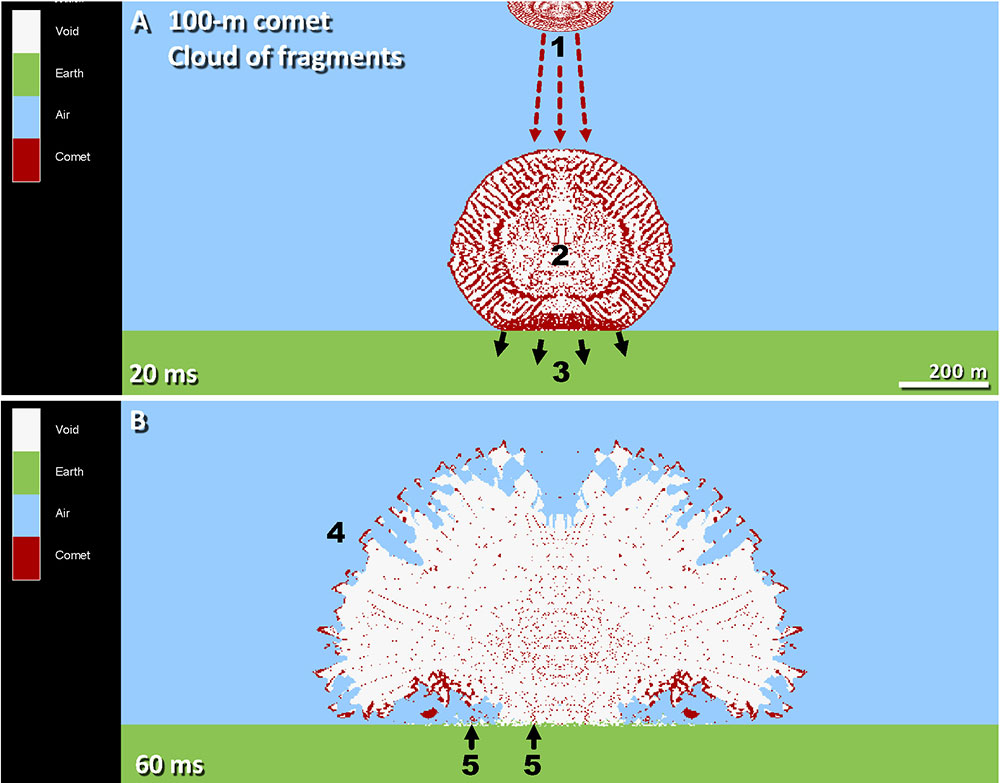
The group’s two new papers focus on different aspects of the Younger Dryas Impact Hypothesis, which posits that a “disentangling comet” broke up in Earth’s atmosphere before plummeting to the ground, initiating a comet-driven cataclysm that leveled humans and mammoths and much else approximately 12,800 years ago.
Christopher Moore, a geoarchaeologist at the University of South Carolina and corresponding author for both papers, told us the group remains “confident in the integrity of the data, the methods employed, and the conclusions drawn.”
In the first article, published Aug. 6, 2025, Moore and his colleagues claim to have unearthed new evidence for the Younger Dryas impact event in Baffin Bay, which separates western Greenland from northeastern Canada. The team scrutinized four marine cores and claimed to have found chemical signatures that hint at the ancient calamity.
The paper was quickly picked up by media outlets, including Gizmodo and Discover magazine, but just as quickly drew scrutiny from outside experts. (Both publications note the work is now retracted.)
Mark Boslough, an airburst expert at the University of New Mexico and frequent critic of the group’s output, commented on PubPeer shortly after the PLOS One article was published.
“The authors completely misrepresented the published criticisms of critics, with citations to a couple critical papers I co-authored,” Boslough told us. He also documented errors he noticed within the research.
The paper accumulated 23 comments on PubPeer from August to December, pointing out instances of missing data, poor citation practices and the potential use of Chat GPT to format the article prior to publication.
There were at least 43 incorrect references, coauthor Marc Young acknowledged in a PubPeer comment. In a now deleted (but archived) comment, Young claims to have “made the unfortunate decision to rely on AI” when formatting the paper’s citations. The procedure likely introduced errors “by way of AI hallucinations,” he wrote. “This should be considered a teachable moment.”
PLOS was contacted by a reader who raised the issue of incorrect references in the paper, Maria Zalm, a senior editor of publication ethics at PLOS told us.
The retraction notice, published Feb. 11, acknowledged concerns “regarding referencing, methodology, and data reporting in this article.” The notice details the potential “undisclosed use of AI tooIs,” multiple “incorrectly used” citations that “do not support the associated statements made,” and several other errors.
The notice also underscores discoveries that directly challenge data the authors used to make claims about the Baffin Bay core samples. These include the misidentification of a subset of samples as comet dust when they were in fact a widespread species of marine plankton called foraminifera, the notice states.
There were also data missing from the supplementary materials, preventing other researchers from independently verifying the paper’s conclusions, sleuth Kevin Patrick wrote on PubPeer under his known pseudonym “Actinopolyspora biskrensis.”
“The chronic ongoing problem, for nearly two decades, is that the Younger Dryas Impact Hypothesis proponents withhold the evidence they claim to have,” Boslough said. “When independent scientists ask to see it — in the form of materials, for example — we are attacked for ‘suggesting fraud.’”
PLOS also looked at other work by the same group, which surfaced issues with the second paper. “As part of our editorial investigation, the papers were reassessed both by the PLOS One in-house editorial team and by external experts,” Zalm said.
In that paper, published Sept. 10, 2025, the researchers claimed to have unearthed shocked quartz — a sign of high velocity impact to soils — and other proxies in soils at three different sites dated to the Younger Dryas boundary. The work focused on Murray Springs, Arizona; Blackwater Draw, New Mexico; and Arlington Canyon, California.
The evidence helps explain documented population declines in megafauna and human cultures across the southern United States, they say.
The retraction notice, also published Feb. 11, calls out missing data, problems with the underlying model used to constrain the age of the cosmic event and a lack of analyses on the sediments above and below the layers associated with the supposed impact. Because of these and other concerns, “it cannot be ruled out” that the reported impact proxies weren’t unique to the Younger Dryas layer, the notice states.
The new criticisms mirror many of those found in the 2021 Scientific Reports paper and those of other published works by the Comet Research Group. There are 85 papers on the Younger Dryas Impact Hypothesis with comments on PubPeer, many of which highlight similar concerns.
“The core issue is procedural” rather than scientific, Moore said, referring to the critiques in the retraction notices. He added he wishes his group was contacted for correction rather than having the papers retracted outright.
Boslough said he hopes the retractions might lead other journals to revisit published papers by this group, given they harbor similar fundamental issues.
“The authors have a very different understanding of the physics of shock waves than working shock wave physicists,” Boslough said.
Like Retraction Watch? You can make a tax-deductible contribution to support our work, follow us on X or Bluesky, like us on Facebook, follow us on LinkedIn, add us to your RSS reader, or subscribe to our daily digest. If you find a retraction that’s not in our database, you can let us know here. For comments or feedback, email us at [email protected].
The comment on PubPeer was deleted by the moderators after they significantly changed my post addressing the issues with AI hallucinations. I was not involved in the use of AI like this article appears to suggest.
Thanks Marc. Who to believe ? This is the question.
The moderator explained (see archive link above):
“[Moderator: minor changes made because our policies preclude attributing responsability (blame) unless supported by publicly available information such as the published author contribution statement.]“
Sounds like Marc initially threw someone under the bus, then someone decided to request that the comment be deleted rather than edited. Was this latter request by Marc, or by one of the senior authors who Marc named?
The conventional view of the Younger Dryas is that a glacial “dam” failed and released huge amount of fresh water into the northern Atlantic.
Now a little meteorology. High pressure systems form above large ice caps. Fine-grained meteor “smoke” settled into the polar ice cap in the winter. It had been accumulating for like 100,000 year. So had coarse pieces of meteorites. There was also older meteorite and impact material eroded from the Canadian shields. The Younger Dryas floods released this material into the environment. Some of it dried out on outwash plains and was blown by the wind.
Thus impact related material is expected with the Younger Dryas