A group of gynecologists in Italy has tallied yet another retraction, this time for an article with “significant overlap” with the methods, data and text of an older paper that shares two of the same authors.
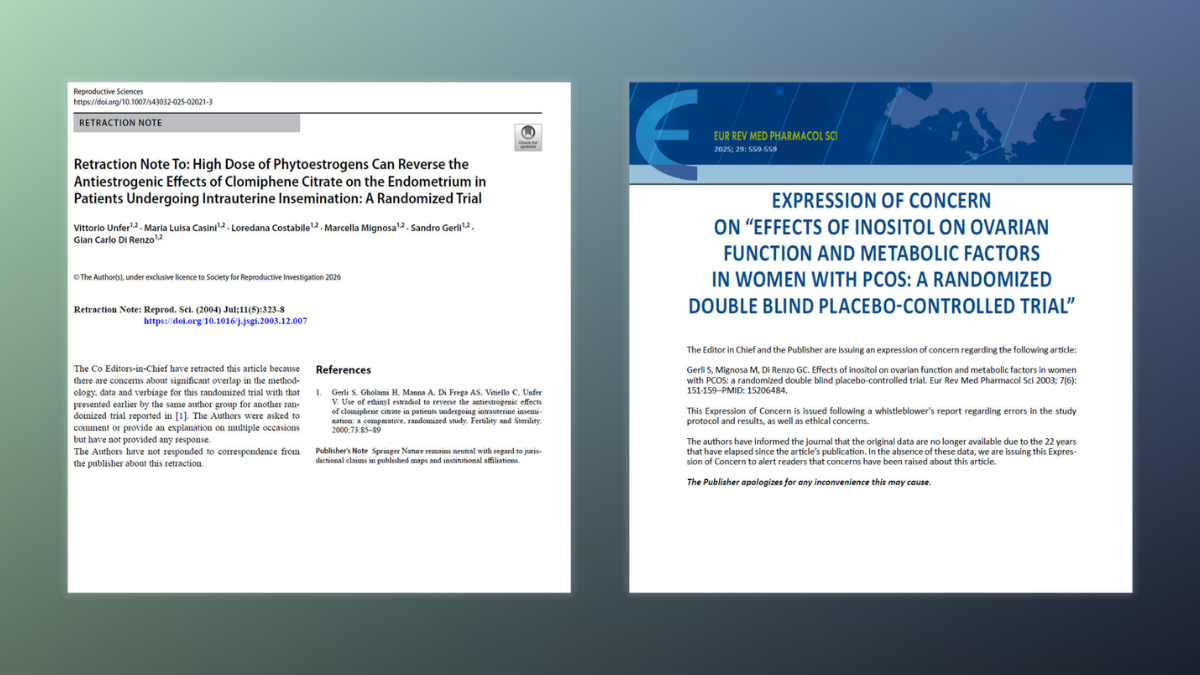
The paper, which involved research on a treatment for infertility, is the latest in a string of retractions for Sandro Gerli and Gian Carlo Di Renzo of the University of Perugia, and Vittorio Unfer, now at Saint Camillus International University of Health Sciences in Rome. Just a few weeks earlier, the researchers also received an expression of concern on a separate paper examining a widely used supplement for polycystic ovary syndrome.
Commenters on PubPeer began to flag the researchers’ papers two years ago, and they now have 11 retractions among them, largely for duplicated data and text across the publications, as well as undisclosed conflicts of interest and unreliable study methods. In 2024, Di Renzo threatened legal action over a critic’s allegations about data duplications among several papers he coauthored — many of which have since been retracted.
The latest retraction, published in January in Reproductive Sciences, came after a commenter on PubPeer raised concerns that the 2004 paper reported identical data points — including the same mean ages and duration of infertility, as well as the same numbers of biochemical pregnancies and miscarriages for the participants — as a supposedly separate trial published in 2000. The notice states that the authors, which include Unfer, Gerli and Di Renzo, didn’t respond to the journal’s concerns.

The December expression of concern on a 2003 paper in European Review for Medical and Pharmacological Sciences follows a whistleblower’s report about the study’s design, reported results and ethical concerns. The authors, who included Gerli and Di Renzo, told the journal the underlying data were no longer available, given more than two decades had passed since the paper was published.
Di Renzo told us the first author, Gerli, had answered the journal’s questions at length, but that the editors didn’t accept his explanations. Di Renzo said the paper’s conclusions have since been confirmed by other studies, “so I do not think there was anything fake in the results to alert readers,” he wrote in an email. “Journal ethical committee[s] are crazy nowadays in search to find fake documents of 25 years ago!”
The journal’s editorial office described the paper’s publication history as “complex.” In our earlier reporting, this 2003 paper had already been linked to a separate 2007 paper in the same journal with two overlapping authors, Gerli and Di Renzo. The 2007 paper had similar statistical values and data points, including the same pregnancy and miscarriage counts, despite reporting different numbers of participants. It was retracted in 2023.

At the time, Gerli wrote on PubPeer that the later 2007 paper had been written by an uncredited student who, unknown to them, had submitted it as new research. “We apologize in hindsight for the lack of attention on our part,” Gerli wrote on PubPeer. “Despite the peer reviews, the journal did not rise [sic] the issue, otherwise we would have clearly correct the overlapping sentences.”
In his email to us, Di Renzo said Gerli had made the decision to retract the 2007 paper without consulting his coauthors.
The editorial office of European Review for Medical and Pharmacological Sciences told us they received new information late last year regarding the 2003 article, leading them to initiate a formal assessment. “While the journal is aware of the broader publication record of the authors,” the email continued, “editorial decisions are made with respect to the individual article under consideration and based on the evidence available.”
Several other papers linked to the group have also been retracted in the past year.
One was retracted in July from the same journal after a third party spotted “a possible high degree of textual similarity” with another paper. After the journal began investigating, the authors themselves, which included Gerli and Di Renzo, requested a retraction because of “a lack of confidence in the accuracy of the information submitted.”
The paper retracted in January had similarities to an earlier 2000 article in Fertility and Sterility by Gerli and Unfer, which was withdrawn last year at the request of the American Society for Reproductive Medicine, which publishes the journal. The society’s research integrity committee found the treatment and control groups weren’t comparable, and the reported reduction in the miscarriage rate associated with treatment was not supported by the data.
Unfer and Gerli have not responded to our requests for comment.

At least four of Unfer’s articles have also been retracted in the past year for undisclosed conflicts of interest, after the journals found that the drugs being studied were produced by companies he founded, owned or directed. The papers included one in Gynecologic and Obstetric Investigation, two in European Journal of Obstetrics and Gynecology and Reproductive Biology, and one in Fertility and Sterility. Aside from the conflicts of interest, some of the papers also included data similarities, as well as invalid statistical analyses.
Another paper in Fertility and Sterility coauthored by Unfer was retracted in 2024 after editors discovered the study had not actually been conducted. Another author admitted that the research had been made up, which no other author contradicted, according to the journal.
Of the retractions where he is listed as an author, Di Renzo told us:
[T]hese are works from more than 15 years ago, original data could not be found anymore, and I believe there was a different perception of publishing ethics in general back then, not as exaggerated as today. The group, as you say, is not a clan of investigators, so there’s nothing systemic about it. I have collaborated and continue to collaborate with hundreds of investigators throughout my career, both nationally and internationally, and sometimes some of them are less thorough and perhaps don’t deserve the trust we give them a priori. In general, I disagree with this type of investigation, which concerns work done and written decades ago, where you may have missed the data object of investigation.
Like Retraction Watch? You can make a tax-deductible contribution to support our work, follow us on X or Bluesky, like us on Facebook, follow us on LinkedIn, add us to your RSS reader, or subscribe to our daily digest. If you find a retraction that’s not in our database, you can let us know here. For comments or feedback, email us at [email protected].