A Nature journal has retracted a decades-old immunology paper that has been cited more than 1,000 times and, the author claims, spurred the development of new drugs.
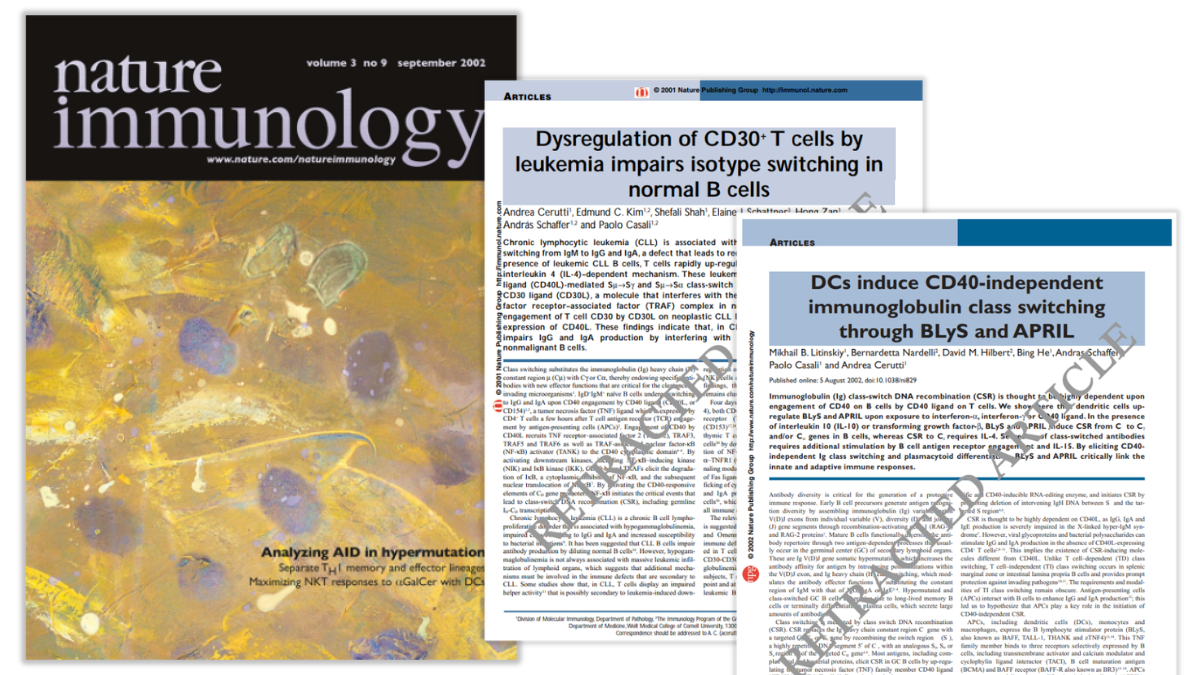
The paper on antibody diversity appeared in Nature Immunology in 2002. The article, cited 1,016 times, according to Clarivate’s Web of Science, is the most cited work for corresponding author Andrea Cerutti, a professor at the Catalan Institution for Research and Advanced Studies in Spain.
The retraction comes on the heels of another retraction for Cerrutti, also for a paper in Nature Immunology. Both had been flagged on PubPeer for image issues. The authors maintain there was no misconduct.
The most recent retraction notice, published Feb. 9, states three of the figures “appear to partially overlap” with or be “highly similar” to those in another of Cerutti’s papers published in The Journal of Immunology in 2002. Three lanes in another figure “present repetitive features within the image,” the notice reads. The authors did not have access to the original data given the age of the article, according to the notice.
Cerutti and his coauthor, Paolo Casali, agreed with the retraction, according to the notice. None of the other authors could be reached, the notice says. Both Cerutti and Casali were researchers at Cornell University in New York at the time the study was conducted. Cerutti also leads a research group at Hospital del Mar Research Institute Barcelona, according to his profile page.

The retractions are the first for Casali and Cerutti, but both researchers have several papers with comments on PubPeer pointing out image similarities.
Casali, a professor at the University of Texas Long School of Medicine in San Antonio, told Retraction Watch there was no misconduct in the papers.
“The data we reported in that manuscript have been replicated multiple times by different laboratories throughout the world,” said Casali, who was formerly chair of the Department of Microbiology and Immunology at the university.
Neither Casali nor Cerutti responded when we followed up asking how the image similarities may have occurred.
“New biologics have been generated thanks to the findings reported” in the 2002 work, Cerutti told us, pointing to an antibody currently being tested in “promising clinical trials.”
PubPeer comments on the paper pointing out similarities between figures began in 2016, the most recent appearing in January of this year. According to emails we have seen, pseudonymous sleuth Claire Francis sent links of the PubPeer comments to the journal earlier this year.
The Journal of Immunology was copied on Francis’ email to the Nature Immunology editors. They did not respond when we asked if they planned to look into the paper published in their journal. Francis said he never heard back from The Journal of Immunology. Matt Lam, director of communications for the American Association of Immunologists, which publishes the journal, told us the journal “does not comment on ongoing or potential investigations” into papers.
According to his CV, Cerutti was an associate editor for The Journal of Immunology from 2004-2008 and a section editor from 2008-2012.
Nature Immunology retracted another paper by Cerutti and Casali on Jan. 9. That article, on immune cell interactions in chronic lymphocytic leukemia, was published in 2001 and has been cited 44 times.
The retraction notice calls out four images, three of which had “highly similar” lanes and one of which “appears to present signs of digital editing.”.
The journal corrected the sources of two antibodies two months after the paper was published. Jamie Wilson, chief editor of Nature Immunology, told us the journal is in the process of investigating three other papers by the same authors.
Retractions “cannot be merely viewed as a punishment, but also as opportunities to learn and improve,” Cerutti said.
Like Retraction Watch? You can make a tax-deductible contribution to support our work, follow us on X or Bluesky, like us on Facebook, follow us on LinkedIn, add us to your RSS reader, or subscribe to our daily digest. If you find a retraction that’s not in our database, you can let us know here. For comments or feedback, email us at [email protected].
“most cited work for corresponding author Andrea Cerutti” retracted. What is the likelihood that the bank transfers still happen?