If a plagiarized paper by an author who claims he didn’t write it disappears from a journal’s website with no notice, did it ever exist in the first place? It’s not just a philosophical question for the researcher whose published paper turned up in another journal under someone else’s name.
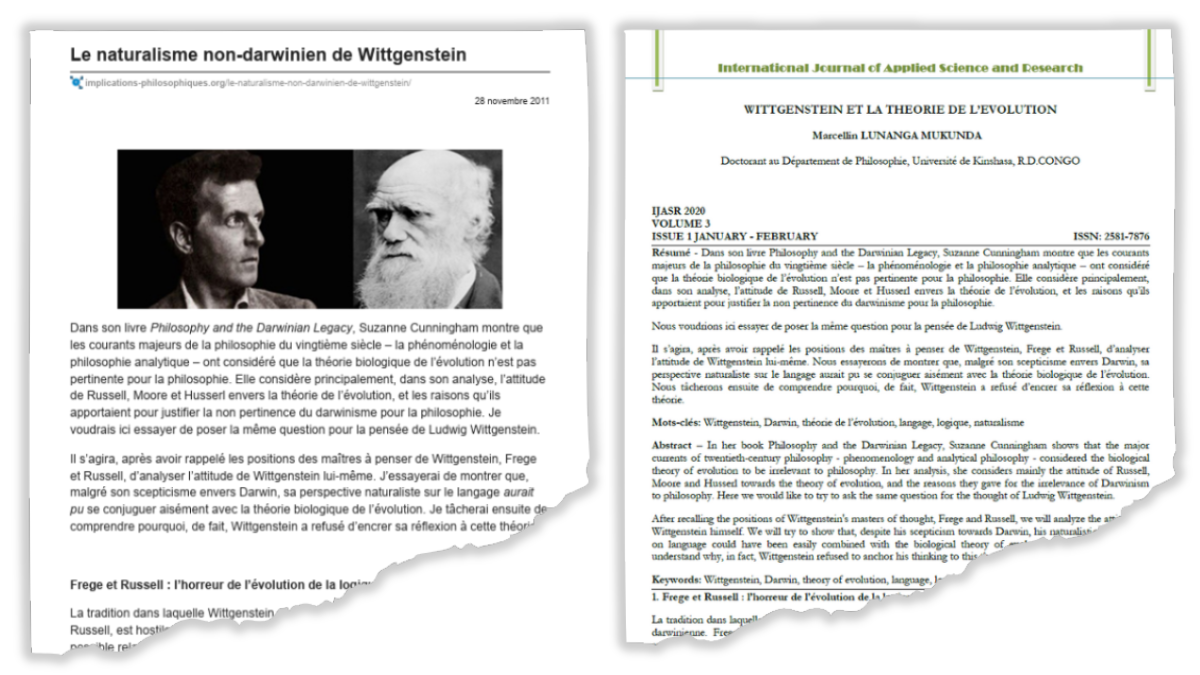
As a master’s student in 2011, researcher Silvia De Cesare published a paper in Implications Philosophiques analyzing a 20th century philosopher’s skepticism of the theory of evolution despite its compatibility with his philosophical views. Now with two doctorates — in ecology and in philosophy — De Cesare is a postdoctoral scholar at Utrecht University in the Netherlands and studies the relationships between evolutionary theory and the idea of progress.
In June last year, De Cesare learned that someone had published a version of her article in the International Journal of Applied Science and Research (IJASR) in 2020. The paper, a near-verbatim copy of De Cesare’s article apart from the omission of a few footnotes, listed Marcellin Lunanga Mukunda, of the University of Kinshasa in the Democratic Republic of the Congo, as its sole author. But Mukunda denies publishing the paper, telling us he had been hacked, or perhaps robbed, as an explanation for how his name appeared on the paper.
In correspondence seen by Retraction Watch, De Cesare contacted the editors of IJASR to report the plagiarism of her work and request the offending paper’s retraction. An editor assistant at IJASR replied, saying the journal would review the matter and remove the paper if the author did not provide a satisfactory response.
After five months with no word from the publisher, De Cesare followed up again, and less than two weeks later, the plagiarizing paper was removed from the journal’s database. The paper was removed “due to substantial plagiarism,” an IJASR editor assistant told us. The PDF of the paper itself was still available online until mid-January, when we contacted IJASR for comments on this matter.
“Removing a paper without a retraction notice (and official excuses) seems to me to be an insufficient reaction for such a patent and serious case of plagiarism,” said De Cesare. According to Committee on Publication Ethics (COPE) guidelines for plagiarism in a published article, publishers should inform readers of the outcome of actions resulting from plagiarism investigations, typically with a correction or retraction notice.
IJASR has not posted a retraction notice on their website. The journal is not indexed in Scopus or Clarivate’s Web of Science. IJASR’s Publication Ethics page contains sections referring to itself as “Journal Sosioteknologi” and shares a significant portion of its text with the Journal Policies page of a journal by that name.
Mukunda, now an associate professor at the Higher Institute of Medical Techniques of Bukavu in the DRC, told us he did not submit the paper. “I have never published an article in the IJARS [sic] journal, which I consider to be predatory,” he said.
Two papers in IJASR listed Mukunda as an author under his University of Kinshasa affiliation, though with no contact information provided. We contacted Mukunda through an email address provided by his current university, which matches an email address from a 2024 paper related to his Ph.D. work at the University of Kinshasa.
“In 2018, my contact details and research data have been hacked,” Mukunda said. When asked to elaborate, he then described an incident of vandalism and theft followed by threatening phone calls. He declined to provide any correspondence, investigation reports, or other evidence supporting either story.
We informed IJASR of Mukunda’s claim that he did not publish with them. “We are currently investigating our submission records and identity verification processes to determine how this occurred and if this is a case of identity theft or a predatory submission,“ the IJASR editor assistant told us. IJASR has not replied to our followup emails about the progress or outcomes of this investigation.
Plagiarism of published papers is a common problem in academic publishing. Just recently we’ve seen retractions for authors copying from colleagues, student theses, rejectedpapers, conference abstracts, preprint papers, and even their own past publications.
Like Retraction Watch? You can make a tax-deductible contribution to support our work, follow us on X or Bluesky, like us on Facebook, follow us on LinkedIn, add us to your RSS reader, or subscribe to our daily digest. If you find a retraction that’s not in our database, you can let us know here. For comments or feedback, email us at [email protected].