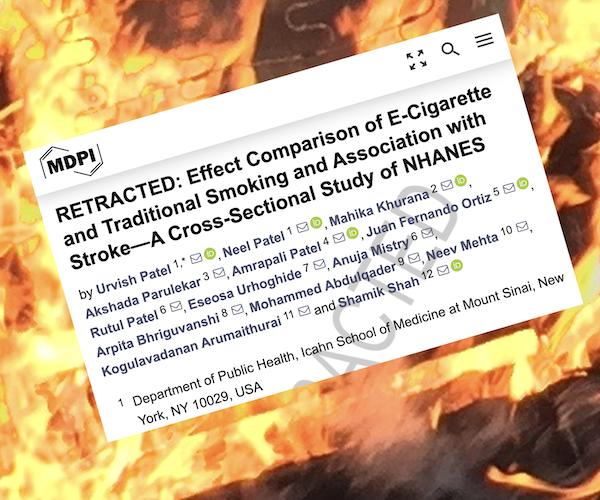
MDPI has retracted a study about vaping that one expert said seemed “like a joke” almost two years after the publisher received a complaint about the flawed work.
The paper, published in Neurology International in 2022, reported e-cigarette users had a higher risk of early stroke than traditional tobacco users. It has been cited 22 times, according to Clarivate’s Web of Science, and was covered in the media, featured in a public campaign against vaping and included in a contestedmeta-analysis.
But the study contained critical errors, as we reported in 2024 in a story for Science that investigated paper mill-like businesses dangling quick-and-dirty publications for international medical graduates looking for residency positions in the United States.
The corresponding author, Urvish Patel, is the founder and director of one such outfit, the Texas-based Research Update Organization. Several or all of his coauthors were international medical graduates who paid to be part of the program. The paper did not mention this fact, but instead misrepresented Patel as being affiliated with the Icahn School of Medicine at Mount Sinai in New York.
At the time of our Science story, Patel defended his publication, telling us it “described very well [the] methodology, data, every single thing.” But experts we consulted were not impressed. Biostatistician and epidemiologist Miguel Hernán of the Harvard T.H. Chan School of Public Health in Boston, for example, told us the “paper seems like a joke” and said no “self-respecting journal should have published this.”
The journal’s retraction notice from December 18 states:
Following publication, concerns were brought to the attention of the publisher regarding several major errors in the data analysis, raising concerns about the validity of the findings.
Adhering to our complaint procedure, an investigation was conducted by the Editorial Office and Editorial Board. Although the authors initially cooperated, they were unable to provide satisfactory explanations or supporting material to resolve the issues identified. Furthermore, attempts to contact the relevant institution for further information were unsuccessful, as no response was received.
The authors did not agree to the retraction, according to the notice.
Patel told us by email he had “a lot to say as usually it won’t take 3.5” years for “3 multivariate” regression models and “10-12 chi-square tests to be proven wrong.”
“But there is no meaning in talking with either faustian or hypocrite person,” he wrote. “I wish I would not choose this topic for research.”
The anti-vaping campaign featuring the study was how it first caught the attention of Gal Cohen and Floe Foxon, both of whom work for companies that provide contract research and have ties to e-cigarette maker Juul Labs. Cohen is Head of Scientific Affairs at the Rose Research Center, and Foxon is a data scientist at Pinney Associates. In late 2023 and early 2024, the two sent several emails to Patel asking about his work, but did not receive any helpful information in reply.
On March 4, 2024, Cohen and Foxon submitted a comment to Neurology International describing all of their concerns, which included a glaring error in the sample size reported in the paper, insufficient stroke observations and a lack of information on whether the strokes occurred before or after vaping began.
In May of that year, following the publication of our Science story, the journal told Cohen and Foxon that instead of publishing their comment, it would initiate an investigation into Patel’s work, according to a PubPeer comment from March 2025 in which the pair laid out the problems with the paper.
“To date,” they wrote, “the only public action taken by Neurology International has been to quietly remove the ‘Editor’s Choice’ badge from the article.”
Finally, on December 18, an MDPI employee told Foxon the publisher had “investigated the article of concern. As a result, our Editorial Board and the Editor in Chief determined that there were too many scientific flaws and decided to retract this article.”
MDPI did not respond to a request for comment.
“It’s reassuring to see the journal take necessary action on such flawed research, and they do deserve some credit for that,” Foxon told us.
“Of course, there is the fundamental question of how this article was published in the first place,” he added. “It seems there are so many errors that anyone remotely familiar with this dataset and these methods should have spotted the issues a country mile away.”
Like Retraction Watch? You can make a tax-deductible contribution to support our work, follow us on X or Bluesky, like us on Facebook, follow us on LinkedIn, add us to your RSS reader, or subscribe to our daily digest. If you find a retraction that’s not in our database, you can let us know here. For comments or feedback, email us at [email protected].