Editors of a materials journal have resigned six years after the title was purchased by a publisher based in Canada, claiming the company “multiplied the number of publications while increasing prices at the expense of quality.”
Revue des Composites et des Matériaux Avancés (RCMA) was published by Lavoisier, a French firm, until late 2018. It was then purchased by the International Information and Engineering Technology Association (IIETA) “without anyone being informed,” former editor-in-chief Francis Collombet wrote in a January 5 resignation email signed by 22 other board members.
The resignation continues: “We, the members of the RCMA editorial board, can no longer serve as a guarantee for IIETA, which, by buying up quality journals, has multiplied the number of publications while increasing prices at the expense of quality.”
Collombet, an emeritus professor at Toulouse University in France, had been editor-in-chief of the journal since 2017. Of the 22 others who resigned, all but two were affiliated with institutions in France. The four editors still listed on the journal’s website come from universities in China, Turkey, South Africa and Uzbekistan. The other editor-in-chief, Changlong Wang, a professor at Hebei University of Engineering in China, also remains on the journal’s masthead.
Collombet told Retraction Watch he did not contact Wang “nor any of the board members that IIETA appointed without consulting me” regarding the resignation.
In their resignation email, the former editors say a 2018 special issue covering a conference was the first produced by IIETA instead of Lavoisier. “This was the last time we were able to produce an issue of RCMA that made sense from a scientific and ethical point of view,” Collombet wrote. Since then, the editors have not had access to peer reviews, he said in the email.
“I have never been asked to review anything,” Collombet told us.
Andrew Zhang, the managing editor at RCMA and several other IIETA journals, responded to our questions, including about access to peer reviews, with a statement:
The review work has always been carried out by the editorial board, and the number of articles we publish is relatively small, which can be easily confirmed on our website. We also keep the APC low in order to support the journal’s ongoing operation. At the same time, we are working to fill editorial board vacancies, with the Co-EiC ensuring that regular publication continues as usual.
RCMA is one of seven journals IIETA purchased from Lavoisier, which was a result of the French publisher’s financial difficulties, Actualitte reported at the time. RCMA is the third journal from which the editorial board resigned en masse after changing hands from Lavoisier to IIETA. It joins our Mass Resignations List as number 50, including 7 from 2025.
Computer scientist Guillaume Cabanac was on the editorial board of the journal Ingénierie des Systèmes d’Information, another IIETA journal formerly published by Lavoisier. The editorial board resigned en masse in 2019 in protest of the acquisition, according to an email we have seen. Since then, he and his colleague Ophélie Fraisier-Vannier have been investigating the Lavoisier-turned-IIETA journals and have documented trends in author affiliations toward institutions primarily in India, China and Iraq, and increases in publication volume and article processing fees. They will present their results at the World Conference on Research Integrity in May.
Fraisier-Vannier, a computer science professor at Toulouse University, shared stats specific to RCMA, including a more-than-doubling in annual publication volume since 2018, from 22.6 in the years 2001-2017 to 55.3 each year since 2018.
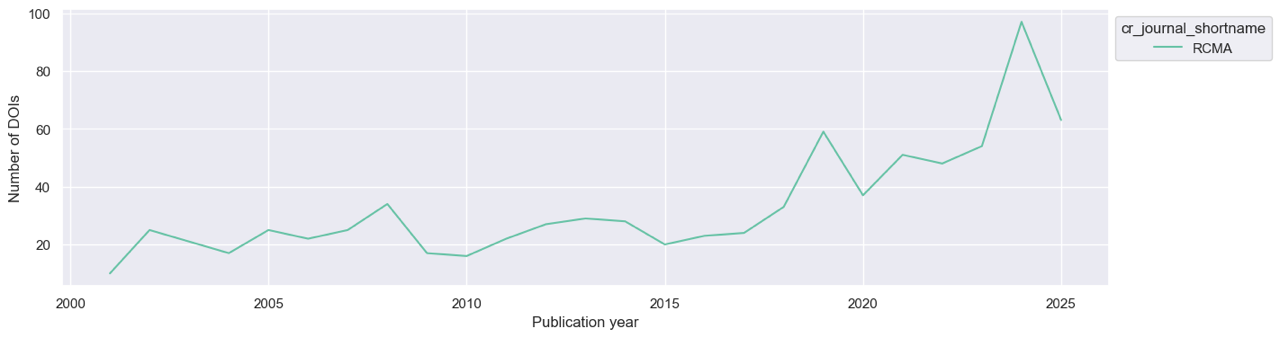
Fraisier-Vannier told us before IIETA bought the journal in 2018, most — 85 percent — of the authors who published in RCMA had affiliations with French institutions. Since the journal changed hands, only 7 percent of published articles have been from researchers working in that country, with over two-third of the articles coming from Iraq, Algeria and India, she said.
In 2019, RadioFrance covered resignations at Artificial Intelligence Review, another Lavoisier journal bought by IIETA. Thirty-seven of its editors, including its editor-in-chief, resigned after the new publisher changed an already published issue to include three articles with authors at Chinese institutions, according to RadioFrance.
Last year, researchers used Oxbridge Publishing House, Ltd. to examine journal buyout trends. They noted the publisher bought journals indexed in Web of Science — as RCMA is — and scaled up publication volumes and costs while lowering academic standards, the researchers said. The Meta News reported in October journals are sold for anywhere up to half a million dollars.
Like Retraction Watch? You can make a tax-deductible contribution to support our work, follow us on X or Bluesky, like us on Facebook, follow us on LinkedIn, add us to your RSS reader, or subscribe to our daily digest. If you find a retraction that’s not in our database, you can let us know here. For comments or feedback, email us at [email protected].
The one weird thing in the story is why it took the board members 6+ years to realize there was an problem and decide to resign.
An explanation is certainly called for. Were the editors flying blind all that time or performing peer review functions themselves? I’m not clear on what “editors” actually do… or did in this case other than lend their names. Clarification would be helpful here.
Hi! I can’t answer in details as I wasn’t part of the editorial board, but here’s what I know: IIETA was contacted from the very beginning but made vague commitments and offered minor concessions to gaslight the editorial board and gain time. For example, they claimed to have maintained a peer-review process by pretending to involve other scientists. As the board members had been asked to maintain the journal at all cost, it probably seemed to them that they were doing the right thing. It’s only when a sleuth -yours truly- reported blatant evidence of fraud that they realised that they had been fooled.
If I may, I would recommend not to make any judgmental comment about the editorial board of RMCA. It can appear evident today that it was a scam, especially if you are well informed about predatory practices, and they now look like gullible, but I don’t know what I would have done at their place. The bottomline is, once properly informed, the editorial board took the right decision. 🙂