Lancet flags long-scrutinized report of infant poisoned by opioids in breast milk

The Hospital for Sick Children in Toronto

The Lancet has put an expression of concern on a 2006 case report of a baby’s death purportedly from morphine poisoning through breast milk. The decision comes just days after the New Yorker published a year-long investigation into the death and the controversies that have surrounded it.

The case report described the 2005 death of a baby boy whose mother had been prescribed Tylenol 3, which contains codeine. Gideon Koren, founder of the now-defunct Motherisk Drug Testing Laboratory at the University of Toronto’s Hospital for Sick Children, used the case for years to claim codeine – which gets metabolized to morphine in the body – can pose a lethal risk to breastfeeding infants.

“It feels like an element of vindication,” David Juurlink, professor of medicine and pediatrics at the University of Toronto, told Retraction Watch of the expression of concern. Juurlink, a pharmacologist and toxicologist who has been pursuing this case for over a decade, requested The Lancet retract the article in 2020, when he and a colleague published a review article calling into question key elements of the case report. The paper, he said, “really does serve as the foundation of an entire branch of pediatric pharmacology that shouldn’t exist.”

Continue reading Lancet flags long-scrutinized report of infant poisoned by opioids in breast milk

‘Kicking the can down the road’: Science flags insect meta-analysis based on allegedly buggy database

An insect meta-analysis published in Science in 2020 has been hit with an EOC. (Photo credit: Aron Sousa)

Science has issued a permanent expression of concern for a paper reporting a meta-analysis of a database including studies critics have said were “experimentally manipulated.” 

The notice, published today, applies to a 2020 meta-analysis measuring population patterns of freshwater and terrestrial insects and predicting what might drive changes in population numbers. According to the notice, the move comes after critics raised concerns about a database, called InsectChange, on which the meta-analysis was based. The database itself was published in 2021 in Ecology, a journal of the Ecological Society of America. 

The Science article has been cited 820 times, according to Clarivate’s Web of Science. The Ecology paper has been cited 23 times. 

Continue reading ‘Kicking the can down the road’: Science flags insect meta-analysis based on allegedly buggy database

COVID-19 paper by scientists at Harvard, Duke gets expression of concern for ‘unreliable’ data

A Science journal has issued an expression of concern over questions about the data in a paper reporting the discovery of an antibody that neutralized all COVID-19 variants in mice.

The article appeared in Science Immunology in August 2022 and has been cited 36 times, according to Clarivate’s Web of Science. The study lists 30 coauthors from Boston Children’s Hospital and Duke University. An article by Boston Children’s published at the time said the findings could “contribute to new vaccine strategies.” 

According to the expression of concern, published November 21, the authors informed the journal of “potential data reliability concerns” with two of the figures. The journal is in the process of determining an “appropriate course of action,” the notice continues. 

Continue reading COVID-19 paper by scientists at Harvard, Duke gets expression of concern for ‘unreliable’ data

IQ paper gets expression of concern as misconduct fallout continues

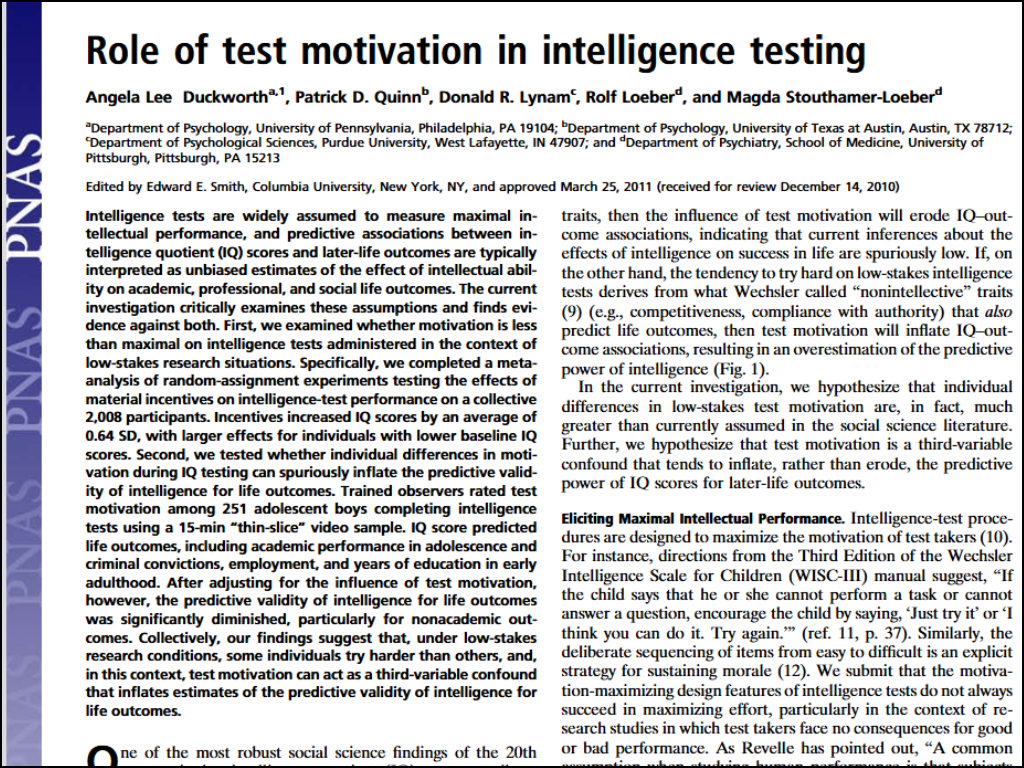
The authors of a paper on how incentives influence IQ have requested an expression of concern after a recent retraction altered the results of their study. 

On January 20, we reported that a paper by embattled researcher and child psychologist Stephen Breuning was retracted decades after an investigation found evidence of scientific misconduct. Breuning’s papers came into question following a 1987 report from the National Institute of Mental Health (NIMH), which found he “knowingly, willfully, and repeatedly” engaged in research misconduct and fabricated results in 10 NIMH funded articles. 

Since then, six of Breuning’s papers have been retracted. The latest retracted article, originally published in 1978, was not part of the investigation but came about “due to concerns about the integrity of the data reported and other issues identified within the NIMH Final Report that clearly established a pattern of ongoing scientific misconduct,” the retraction notice read.

Continue reading IQ paper gets expression of concern as misconduct fallout continues

Sage slaps more than 100 papers from one journal with expressions of concern

The Sage journal American Surgeon has issued a mass expression of concern for 116 articles. 

The expression of concern states the journal “was made aware” of “concerning author activity” on the articles.

Sage is no stranger to mass editorial actions. In 2023, the publisher pulled large tranches of papers at least three times, and last year it retracted over 450 papers from a journal the company had acquired from IOS Press. The publisher was one of the first to begin retracting papers in bulk, primarily to combat manipulated peer review. 

Continue reading Sage slaps more than 100 papers from one journal with expressions of concern

Science places expressions of concern on two articles as Toronto’s Sinai Health investigates

Daniel Durocher

Science has issued expressions of concern for two articles from the lab of Daniel Durocher, a professor of molecular genetics at the University of Toronto. 

The notices, and two more editor’s notes on Nature articles, follow PubPeer comments on several of Durocher’s papers pointing out potentially duplicated images, as described by ForBetterScience. Durocher has responded to many of the comments promising to look into the issues. 

Besides his academic positions at Toronto and the Lunenfeld-Tanenbaum Research Institute at Sinai Health, Durocher co-founded Repare Therapeutics, a biotech company with five ongoing clinical trials of potential treatments for cancer. 

The two Science articles, “Mitosis inhibits DNA double-strand break repair to guard against telomere fusions” from 2014, and “Orchestration of the DNA-damage response by the RNF8 ubiquitin ligase,” from 2007, together have been cited nearly 1,000 times, according to Clarivate’s Web of Science. 

Continue reading Science places expressions of concern on two articles as Toronto’s Sinai Health investigates

‘Mistakes were made’: Paper by department chair earns expression of concern as more questioned

Kelly McMasters

A 14-year-old paper has earned an expression of concern after an anonymous whistleblower found evidence of image duplication in the work. 

The authors have had images from several more papers flagged on PubPeer. The corresponding author, Kelly McMasters, is chair of the Hiram C. Polk, Jr., MD Department of Surgery at the University of Louisville School of Medicine in Kentucky. 

The 2010 paper, “Adenovirus-mediated expression of truncated E2F-1 suppresses tumor growth in vitro and in vivo,” appeared in Cancer. It has been cited 12 times, according to Clarivate’s Web of Science. 

Continue reading ‘Mistakes were made’: Paper by department chair earns expression of concern as more questioned

Expression of concern coming for paper some used to link COVID-19 vaccines to deaths

The journal BMJ Public Health is placing an expression of concern on a paper it said “gave rise to widespread misreporting and misunderstanding,” namely, “claims that it implies a direct causal link between COVID-19 vaccination and mortality.” 

The article, “Excess mortality across countries in the Western World since the COVID-19 pandemic: ‘Our World in Data’ estimates of January 2020 to December 2022,” appeared online June 3, and quickly attracted attention and criticism. The expression of concern is not yet live. 

In their conclusions, the authors wrote: 

Continue reading Expression of concern coming for paper some used to link COVID-19 vaccines to deaths

Embattled researcher Didier Raoult earns more than 100 expressions of concern and another retraction

Didier Raoult

An Elsevier journal has issued just over 100 expressions of concern for papers published by a group of researchers led by the French microbiologist Didier Raoult, who also notched a new retraction – his tenth – in a separate publication.

As we and others have reported, Raoult’s work during the COVID-19 pandemic drew intense scrutiny from data sleuths, most notably Elisabeth Bik – whose critiques, which extended beyond his COVID studies, were met with vicious online trolling and a legal complaint filed by Raoult himself. 

The allegations prompted an ethics investigation by the French National Agency for the Safety of Medicines and Health Products into Raoult’s research during his tenure at the IHU Méditerranée Infection, in Marseille, which he led between 2011 and his retirement as director in 2022. That inquiry found “serious shortcomings and non-compliances with the regulations for research involving the human person.”

The 101 expressions of concern come for papers Raoult and his colleagues published in New Microbes and New Infections. Here’s an example of one of the EoC’s, for “Genome sequence and description of Anaerosalibacter massiliensis sp. nov.,” which Raoult’s group published in March 2016:

Continue reading Embattled researcher Didier Raoult earns more than 100 expressions of concern and another retraction

Cancer paper earns expression of concern nearly two years after investigation report is revealed

Carlo Croce

A Springer Nature journal has issued an expression of concern for a 16-year-old paper by Carlo Croce, the cancer researcher – and noted art collector – at The Ohio State University three years after the publication had received a correction for problematic images and roughly 20 months after the news division at Nature reported on a pair of institutional investigations into problems with Croce’s work. 

As we and others have reported, those investigations concluded Croce had not committed misconduct but had overlooked the misdeeds of others in his lab. 

Here’s the notice for the paper, “MicroRNA signatures of TRAIL resistance in human non-small cell lung cancer,” which Oncogene published in 2008:

Continue reading Cancer paper earns expression of concern nearly two years after investigation report is revealed