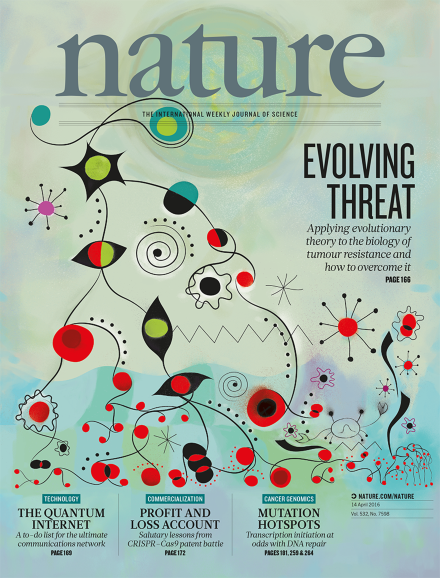
Nature has retracted a paper on melanoma after an investigation by the journal found issues with data that rendered certain results statistically insignificant. A separate institutional investigation concluded misconduct wasn’t involved, the lead author says.
The research behind the article, published in April 2016, was conducted in the lab of Ashani Weeraratna, then at the Wistar Institute in Philadelphia. The paper has been cited 332 times, according to Clarivate’s Web of Science. The study investigated how the tumor microenvironment affected the spread of young versus aged cells.
An editorial investigation found some results in a figure were “no longer statistically significant, which affects the conclusions about therapy resistance,” according to the October 29 retraction notice. The inquiry also found “several errors in image and source data consistency,” as well as errors with the sample numbers given in the original study.
Other authors on the paper — of which there are 46 total — are at Yale University, Mass General Hospital, Johns Hopkins, the University of Pennsylvania, the University of California, Los Angeles, the National Institute on Aging, and other prominent institutions. Four of the authors agreed with the retraction, 28 disagreed, and 14 didn’t respond, according to the notice.
One of the authors who agreed with the retraction, Hsin-Yao Tang, was coauthor on another Wistar paper which was retracted in 2021 for data inconsistencies, as we reported at the time. He did not respond to our request for comment.
The paper received a correction in 2016 for labels in a figure that were “inadvertently reversed.” In August 2023, the journal placed an expression of concern on the paper alerting readers the “reliability of some of the data presented in this manuscript is currently in question.”
An anonymous user on PubPeer posted three comments in September 2022 pointing out inconsistencies in images provided in the raw data versus the published versions.
A different user commented the following month that the raw data for one of the figures had “many points followed by” asterisks. “If we exclude these points and graph the data, the graph and stats match the published version of the graph,” the user wrote. When the asterisked points were included, “the conclusions are no longer valid,” they added.
Other commenters noted missing data or further discrepancies between the raw and published data for the experiment.
Weeraratna, the corresponding and lead author on the paper, is now a researcher at Johns Hopkins and a member of the NIH National Cancer Advisory Board. She told Retraction Watch some results were “mistakenly labeled as outliers.” She also told us Wistar had formed an outside committee for an inquiry into the discrepancies. “The inquiry found no scientific misconduct,” she said, but added she could not discuss the matter further because of a confidentiality agreement.
Francesca Cesari, chief biological, clinical and social sciences editor for Nature, told us the institute did not contact the journal regarding the investigation. Darien Sutton, the director of media relations at Wistar, declined to comment.
The researchers repeated the experiment in 2023 “with improved, less toxic, standard-of-care inhibitors unavailable at the time of the original work,” Weeraratna said, which confirmed the paper’s original conclusions.She said the researchers sent the results of this experiment to the journal, but “Nature did not consider these.”
Cesari told us the experiments “were not an exact replication of the original work. While we carefully considered the information provided, it did not change our assessment of the concerns raised about the original publication.”
Another Nature paper from the Weeraratna lab also drew attention on PubPeer shortly after it was published in 2022, with users pointing out similar issues to the retracted paper, such as inconsistencies with raw and published data, excluded values and unexpected image similarities. Weeraratna responded to several of these comments on the PubPeer thread to explain the discrepancies. The authors published a correction in January 2025 to address the issues. Nature told us they are looking into the paper further.
Like Retraction Watch? You can make a tax-deductible contribution to support our work, follow us on X or Bluesky, like us on Facebook, follow us on LinkedIn, add us to your RSS reader, or subscribe to our daily digest. If you find a retraction that’s not in our database, you can let us know here. For comments or feedback, email us at [email protected].
“The inquiry found no scientific misconduct,” she said, but added she could not discuss the matter further because of a confidentiality agreement.
What??? Why would a confidentiality agreement be required? Science doesn’t operate like this….